An Intern Threw Coffee On Me, Proclaiming The Ceo Was Her Husband. So I Called Him…
“Your new wife is throwing coffee on me.”
Those were the words that started the end of my old life. But before the storm, there was the calm.
The massive Boeing 787 touched down heavily on the runway at JFK International Airport. After more than 12 hours of continuous flight from Frankfurt, the roar of the engines gradually subsided, returning a quiet stillness to the business class cabin. I closed the book I’d been reading, smoothed the creases on my trousers, and pulled my carry-on from the overhead compartment as I walked out the jet bridge.
The humid, bustling air of a New York summer hit me in the face, carrying the familiar gritty scent of the city. For anyone who’s been away, it feels strangely like coming home.
My name is Catherine Hayes, and I am 32 years old. To the outside world, I am the woman who has it all. I am the sole heiress of the late chairman of the Apex Medical Group, holding a 60% controlling stake.
I possess the ultimate decision-making power in one of the largest private hospital systems in the United States. But the world doesn’t see the crushing weight of that glittering title. Since my father’s sudden passing from a severe illness, my shoulders have borne the weight of his colossal legacy.
I’ve had to navigate a boardroom of cunning, old-money shareholders while trying to maintain a semblance of a happy family life. This business trip to Germany had lasted exactly one month. I had to personally visit factory after factory to negotiate the acquisition of a fleet of state-of-the-art medical equipment for our flagship hospital.
This was a responsibility that should have fallen to my husband, Mark Thompson, the man currently occupying the CEO’s chair. But I knew his capabilities all too well. Mark was handsome, charismatic, and a master of networking and charming people.
However, when it came to technical details or battling it out in negotiations in English—let alone German—he was completely out of his depth. Out of love for my husband and a desire to solidify his position before a demanding board of directors, I had agreed to step into the background. My official title was Chief Strategy Officer.
In reality, though, I was the one clearing the path, handling every major and minor detail so he could shine.
A sleek black town car was waiting for me at the VIP arrivals terminal. It glided smoothly over the Whitestone Bridge, heading towards the heart of Manhattan. I didn’t want to go home just yet.
I wanted to report the results of my trip to the board. More importantly, I wanted to see for myself how my husband had been running the hospital during my month-long absence. Apex University Hospital rose majestically from a prime piece of real estate on the Upper East Side.
The 20-story modern marvel of blue-tinted glass reflected the brilliant afternoon sun. It was the culmination of my father’s life’s work. Looking at the polished sign with its stylized cross logo, a wave of pride washed over me, mingled with a vague, inexplicable anxiety.
I told the driver to drop me at the main entrance, deciding to pull my own suitcase through the lobby instead of using the private executive entrance. I wanted to see the hospital’s daily operations through the eyes of an ordinary visitor. I needed to hear the authentic sounds of this place, not the polished versions presented in glossy boardroom reports.
The main lobby was teeming with people. The automated chime of a PA system called out patient numbers. Families murmured anxiously to one another.
The hurried footsteps of doctors and nurses created the unique, chaotic symphony of a busy hospital. The faint, clean scent of antiseptic hung in the cool, centrally conditioned air. I stood in a quiet corner near the reception desk, adjusting the lapels of my white pantsuit.
I planned to observe for a moment before heading up to Mark’s office on the fifth floor to surprise him. But my eyes were frozen by a scene unfolding in the center of the lobby, where the main corridors intersected. A tall man in white scrubs was kneeling on the cold marble floor.
It was Dr. David Chen, head of cardiology, my old friend from medical school and the hospital’s most indispensable clinical asset. He was performing CPR on a middle-aged man who had just collapsed from a hypoglycemic attack. Sweat beaded on David’s broad forehead, running down his strong nose and dripping onto the floor.
His movements were swift and practiced, yet filled with a gentle, focused care.
“Give him some space. Let the man breathe,” David’s deep, authoritative voice echoed through the lobby. “Nurse, I need a glucose meter and a glass of warm sugar water, now!”
I stood there, watching him in silence. David hadn’t changed in 15 years. He was the man who had spent his youth quietly looking out for me, a brilliant talent who never cared for fame or fortune.
The day my father died, it was David who stood vigil by the casket for three days and nights, arranging everything perfectly. Meanwhile, Mark was busy entertaining foreign dignitaries. Watching the way David cradled the patient’s head, his focus so intense he was oblivious to the world around him, I felt a profound sense of admiration.
That was the image of a true healer, a soul shining brightly in a world often clouded by money and ambition. But this beautiful portrait of medical ethics was instantly defiled by a splash of black ink. Just a few yards from where David was saving a life, near the constantly spinning revolving doors, a very young woman stood with her hands on her hips.
Her shrill voice tore through the hospital’s solemn atmosphere.
“Hey, what is wrong with you? I told you to park my Mercedes in the shade. Why is it sitting out there in the sun? Do you have any idea how hot black leather seats get? You’re going to ruin my designer purse!”
She was a girl of about 22, her face caked in heavy makeup, her lips painted a garish shade of red. She wore a hot pink bodycon dress so short and tight, it was grossly inappropriate for a medical setting. It revealed a stretch of skin that was more jarring than attractive.
Pinned to her chest was a blue intern’s badge that read: Tiffany.
Henry, the elderly valet, a Vietnam veteran who had worked here since my father’s time, stood before her. His hair was now white as snow. He was bowing his head, flustered by the condescending attitude of a girl young enough to be his granddaughter.
“I’m so sorry, Miss,” Henry stammered. “It’s been so busy with cars coming and going, I haven’t had a chance yet. I’ll move it for you right now.”
Tiffany didn’t even bother to listen; she stomped her foot on the marble floor.
“Well, hurry it up! You move like a turtle. How does someone like you even get a job at a five-star hospital like this? You’ve completely ruined my morning.”
Having finished berating the older man, Tiffany immediately pulled the latest iPhone from her designer handbag. She switched to the front-facing camera, and her entire demeanor shifted in a flash. Her scowl transformed into a bright, sickeningly sweet smile as she began chattering into the screen.
“Hi everyone! Good morning to all my amazing followers. Your girl Tiff had a little drama with some incompetent staff this morning, but whatever. For the greater good of public health, I have to stay positive and cute. Show me some love guys, tap that heart, and share my live stream!”
I glanced at my watch. It was 9:15 a.m. An employee, more than an hour late for her shift and dressed in violation of the code of conduct, was now standing in the main lobby yelling at an elderly colleague.
Worse, she was live-streaming her personal drama during work hours. The blood began to rush to my face, a vein throbbing in my temple. Was this the professional standard Mark had sworn to me he would uphold?
Was this the face of the culture my father and I had worked so tirelessly to build? The stark contrast between the two scenes was impossible to ignore. On one side, David was on his knees, his shirt soaked with sweat as he saved a life.
On the other, this vapid intern was putting on a ridiculous show for social media. It made it impossible for me to remain a silent observer. I clenched the handle of my suitcase and took a deep, steadying breath to regain the composure of a leader.
I took decisive steps toward the entrance. I walked over to Henry and gently placed a hand on his shoulder to reassure him. He flinched, then looked up, his age-worn eyes widening in recognition.
He was about to greet me as Chairwoman, but I quickly put a finger to my lips, signaling for him to remain silent. I didn’t want my identity revealed just yet. I wanted to see how this little drama would play out.
I turned to the girl, Tiffany, who was still absorbed in pouting and posing for her phone.
“Excuse me,” I said, my voice quiet but firm and authoritative. “This is a hospital, a place of healing, not a fashion show or a marketplace for you to be shouting at your elders. Furthermore, the workday begins at 8 a.m. It is now past 9. You are late, and you are causing a public disturbance.”
Interrupted from her narcissistic reverie of virtual hearts and compliments, Tiffany looked visibly annoyed. She lowered her phone, her eyes narrowing as she scanned me from head to toe with a dismissive air. I was wearing a simple, elegant white pantsuit with minimal jewelry.
After a 12-hour flight, my face was tired and pale with little makeup. In the eyes of this flashy young woman, I was probably just some frumpy patient’s relative or an uptight middle-aged woman.
“And who are you to stick your nose in my business?” Tiffany sneered, her tone dripping with contempt.
“I’m reprimanding my employee,” I replied.
“If you’ve got nothing better to do, go find a seat somewhere else and stop bothering me. I’m trying to engage with my fans.”
With that, she raised her phone again, crudely shoving the camera in my face. Her voice became high-pitched and grating.
“Look at this, everyone! My day is already ruined by some bitter old hag. Probably got dumped by her husband, her life’s a mess, so she comes out here to start trouble. Poor little Tiffany, getting bullied even at work!”
The girl’s insolence and audacity were beyond anything I could have imagined. My initial plan was a simple reprimand before heading to my office and having HR deal with her. But this level of disrespect could not be tolerated.
“Put the phone down. Now,” I said, my voice low and menacing, my eyes locked on hers. “I am asking you to respect the hospital’s regulations and the dignity of others. If you continue to film without permission and insult people, I will have security escort you out and file a formal complaint.”
“Ooh, are you threatening me?” Tiffany’s eyes widened, her heavily made-up face twisting into a sneer.
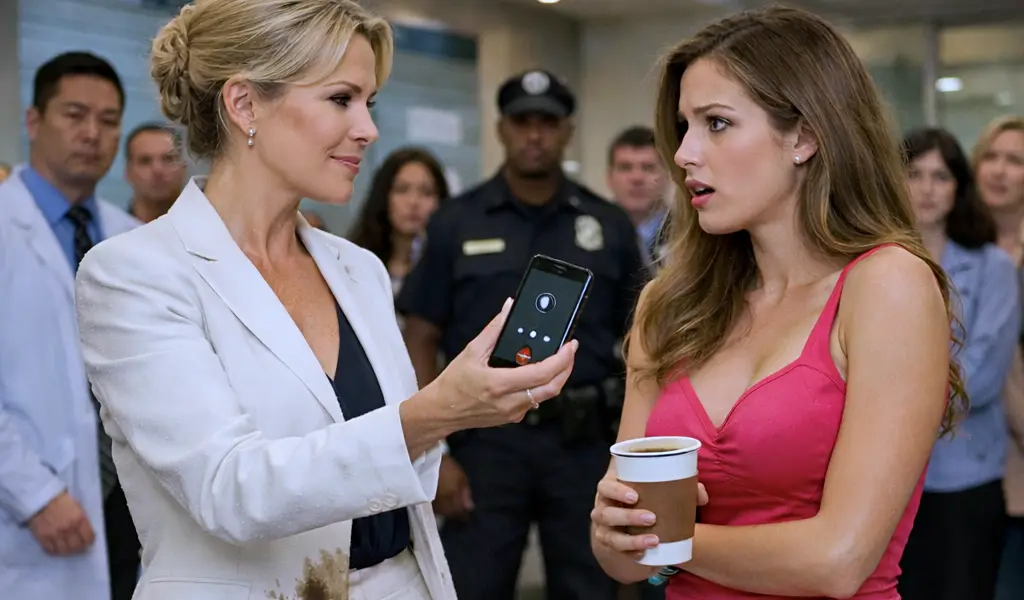
Suddenly, she did something I never would have anticipated. Holding a large, half-finished iced coffee, she pretended to turn awkwardly. In reality, she deliberately slammed into me.
The entire cup of cold, dark liquid drenched my pristine white pantsuit. The coffee spread quickly, soaking through the fabric and dripping onto the floor, forming a dark puddle at my feet. The sticky, chilling sensation made me shudder.
The strong smell of coffee filled my nostrils. This suit had been a gift from my father on his last birthday. Now, it was stained by this petty, calculated act.
Before I could even react, Tiffany burst into a theatrical wail. Her fake sobs echoed through the lobby, drowning out the PA system and drawing the attention of everyone around.
“Oh my god, what did you do? Can’t you watch where you’re going? You pushed me! You ruined my beautiful dress!”
She sobbed hysterically while simultaneously glancing at her phone’s livestream, her performance worthy of an Oscar. Crocodile tears streamed down her cheeks.
“Everyone, you’re all my witnesses! This woman, some crazy patient’s relative, just assaulted a healthcare worker! That’s me! My baby gave me this dress! It’s custom-made! It cost like two thousand dollars! It’s ruined! How am I ever going to get this stain out?”
A murmur went through the crowd. People who hadn’t seen what happened looked at me with expressions of disapproval and pity. Some even took out their own phones to record the chaos.
Seeing she had the audience’s attention, Tiffany pressed her advantage. She stepped closer to me, lowering her voice to a venomous whisper only I could hear.