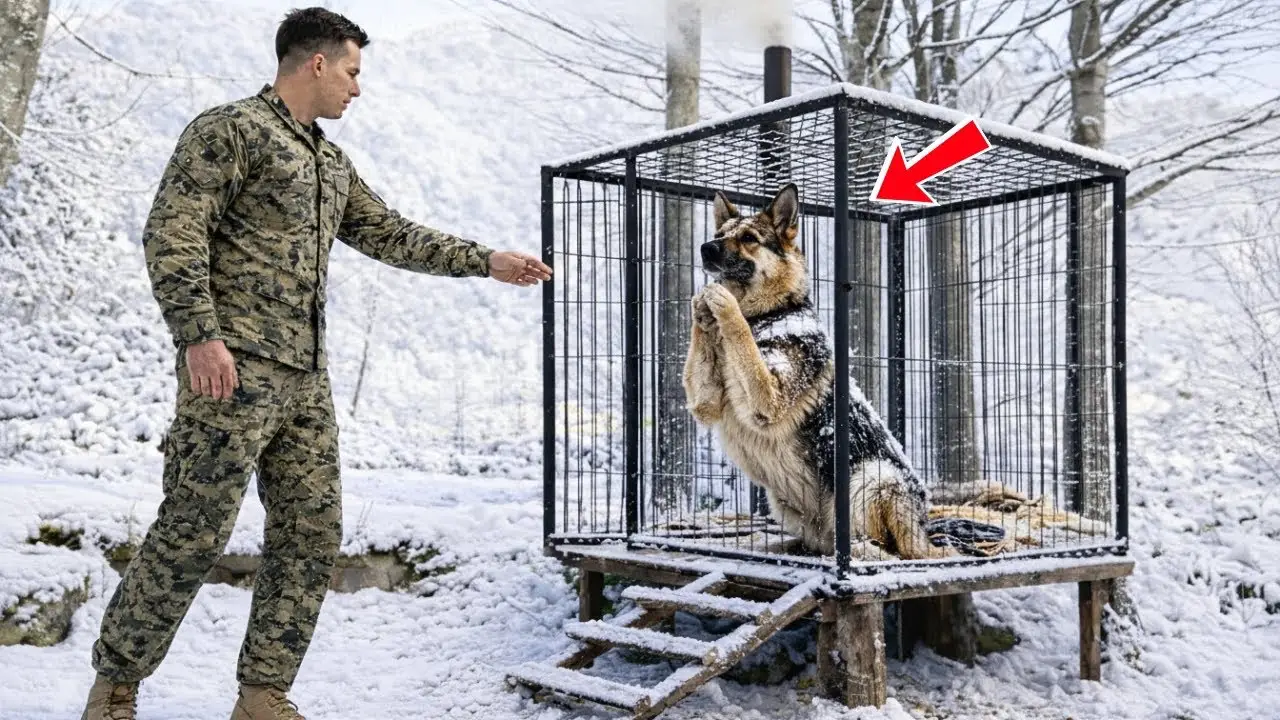
A German Shepherd Was Left to Freeze in a Steel Cage — A Navy SEAL Saved the Entire Forest
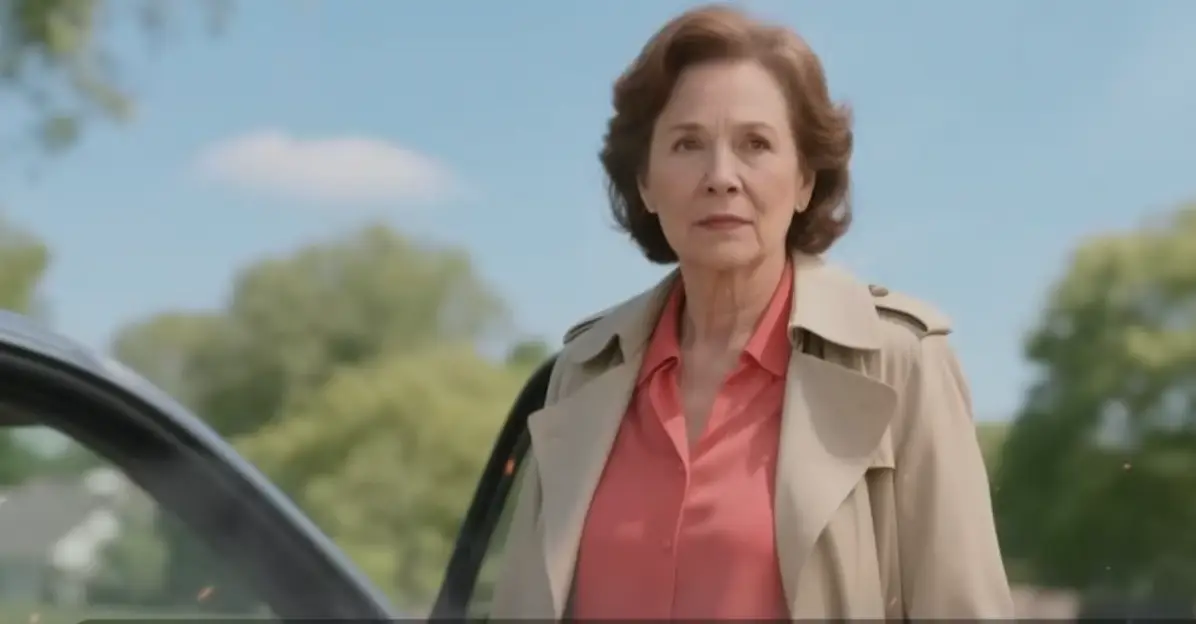
He called Dr. Mara Voss before the kettle finished boiling. Mara arrived within half an hour, her old Subaru crunching into the driveway. She moved quickly but without panic, a woman in her early forties with brown hair pulled into a low, practical tie, and a calm that came from long nights making decisions that mattered.
Her face was narrow, her eyes steady, and her hands bore the faint scars of someone who worked with animals that didn’t always want help. She shrugged off her coat and knelt by the dog, speaking softly, letting him sniff her gloves.
«Severe hypothermia,» she said after a few minutes, her voice level. «Dehydration. Early-stage pneumonia, if I’m reading the lungs right. And this?»
She touched the fur at his neck gently, revealing a faint groove in the skin. «He was tethered for a long time. Not recently, but long enough for it to shape him.»
She glanced up at Cade. «You didn’t find him by accident?»
«No,» Cade said. «Someone put him there.»
Mara nodded once. «Then we stabilize first. Warmth. Fluids. Antibiotics. No rushing.»
«His system’s been living in emergency mode,» she continued. She gave the dog a careful injection and wrapped him more securely, explaining each step aloud as much for the dog as for Cade. When she finished, she stood and wiped her hands on a towel, eyes lingering on the animal.
«He’s not feral,» she added. «He’s trained. Or he was.»
That night, Cade slept in a chair by the stove, boots still on, jacket draped nearby. The dog did not sleep much at all. He dozed in short intervals, waking at every sound, head lifting, ears flicking.
When the wind rattled the chimney, he growled low in his chest—not loud enough to alarm, but enough to announce awareness. Cade watched it all, saying nothing. He had learned the value of silence with things that were deciding whether to trust you.
By morning, the dog could stand more steadily. He paced the small living space, always positioning himself between Cade and the door, between Cade and the windows. When Cade reached for a coil of rope near the workbench, the dog froze, hackles lifting, breath quickening.
Cade set the rope down immediately and stepped back. The reaction faded, but it stayed with him.
«Bishop,» Cade said later that afternoon, testing the name as the dog stood squarely in the doorway, watching the snow fall. The name fit the way he held himself: serious, grounded, as if guarding something sacred.
The dog’s ears twitched. He didn’t look back, but his posture softened a fraction. Cade took that as acceptance.
Over the next two days, Bishop’s strength returned in small, measurable increments. He drank without hesitation, ate slowly, and allowed Mara to check his leg, which showed signs of an old fracture that had healed poorly. She explained it plainly: untreated injury, compensated movement, chronic pain managed through habit.
Bishop accepted her touch but never stopped watching the room. He reacted sharply to the sound of heavy trucks passing on the road below town, a low growl rumbling in his chest. He also shied away from the smell of gasoline when Cade refueled the generator outside.
These weren’t random fears. They were associations, patterns burned in by repetition. Late on the third night, the hook came quietly.
Cade was cleaning a pan when Bishop suddenly rose from the floor, body rigid, eyes fixed on the door. Without barking, he crossed the room and nudged Cade’s leg insistently, then turned and pressed his nose against the door frame. Cade hesitated, then grabbed his jacket and stepped outside.
The cold bit hard, but Bishop led him straight to the edge of the porch. There, half-buried under fresh snow, lay a steel animal trap, jaws rusted but set, its chain disappearing toward the tree line. Nearby, the snow was marred by tire tracks, shallow but recent, still holding the shape of tread.
Cade crouched and touched the metal. It was cold, but the surrounding snow was disturbed in a way that spoke of minutes, not hours. Someone had been here.
Someone had followed them down from the mountain. Cade stood slowly, scanning the darkness. There was no engine sound, no light, nothing to confront.
Bishop stayed close, not panicked, but alert, eyes tracking the woods with focused intensity. Cade felt the old calculations surface in his mind—the part of him that measured distance, intent, and timing. This wasn’t a warning left for him. It was reconnaissance. A test.
He brought the trap inside, locking it away, and spent the rest of the night awake. In the morning, he called Sheriff Nolan. Nolan arrived midday, his heavy winter coat dusted with snow, his lined face tightening when he saw the trap.
«We’ve had reports,» Nolan said. «Poaching, illegal logging… nothing that stuck.»
He glanced at Bishop, who watched him with steady eyes. «But this changes things.»
Bishop remained near Cade throughout the conversation, his presence calm but deliberate. When Nolan stood to leave, Bishop followed him to the door, then stopped, sitting squarely in front of it until Nolan turned back. For a moment, man and dog regarded each other.
Nolan nodded slowly. «Looks like he’s made his choice,» he said.
That evening, as the light faded again, Cade sat on the porch steps with Bishop beside him, the forest quiet in that deceptive way that hid movement. Cade rested a hand on the dog’s broad neck, feeling the warmth there now, real and solid. He understood something then with a clarity that settled deep.
Whatever had been done to Bishop was not over, and whatever Bishop remembered was going to matter. Warmth could save a body, but it could not erase a history written in muscle and instinct. And Cade, who had learned the hard way that memory was not an enemy but a signal, accepted that this chapter was only beginning.
The knock came just after noon, a firm, practiced rhythm that did not belong to neighbors. Cade heard it from the back of the cabin and felt Bishop register it a half-second sooner. The dog rose from his place by the window, body stiffening, ears locking forward, a low vibration starting in his chest that never quite became a growl.
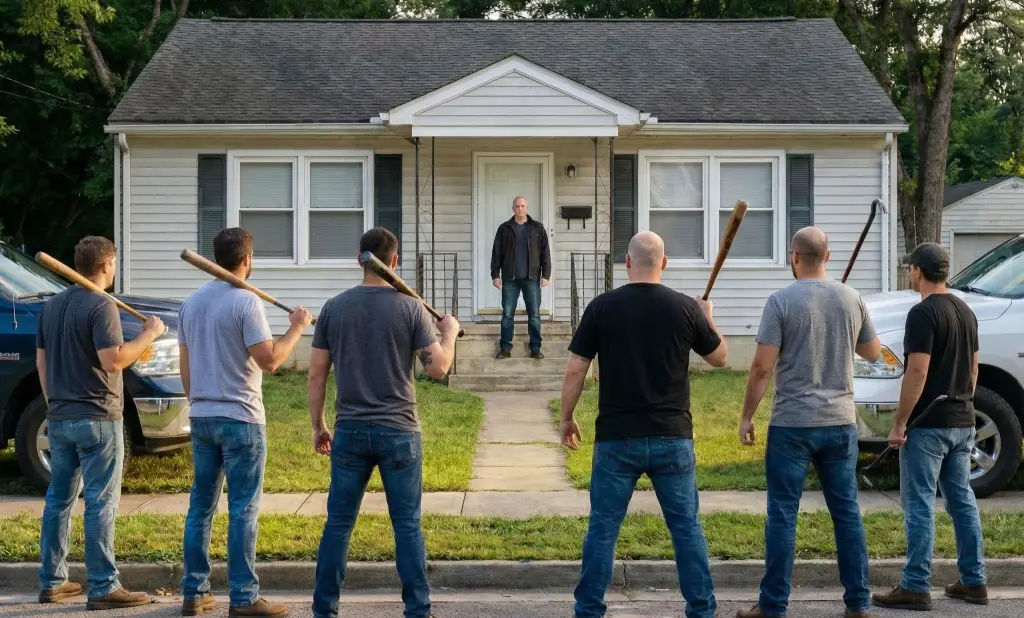
Cade crossed the room, opened the door, and found three men standing on the porch with the snow at their boots and a confidence that felt rehearsed. They wore work jackets scuffed at the elbows, cargo pants dulled by sap and dirt, and boots heavy enough for the woods. On the surface, they looked like every other crew that passed through Pineville during winter, but their faces told a different story.
The tallest one had a long, narrow jaw and a beard trimmed just enough to look deliberate, with eyes that kept flicking past Cade’s shoulder into the cabin. The second was broader, red-faced from cold or drink, with hands that never stopped moving, fingers tapping against his thigh as if counting. The third, shorter and wiry, stood slightly behind the others, pale eyes hooded, expression blank in a way Cade had learned to distrust.
«We’re looking for our dog,» the tall one said, voice easy, almost friendly. «Name’s Bishop.»
He held up his phone and swiped to a photo, grainy and poorly lit, showing a German Shepherd at a distance. The dog in the image could have been any Shepherd if you didn’t know what to look for. «He went missing a few days back. Someone said you brought a dog down from the mountain.»
Before Cade could respond, Bishop stepped forward and planted himself squarely between Cade and the doorway. His posture changed completely: shoulders squared, head high, teeth not bared but ready, hackles lifting along the dark ridge of his back. His amber eyes fixed on the men with a cold intensity that made the shorter one shift his weight.
This wasn’t fear. It was recognition. Cade felt it like a click inside his chest.
«He’s recovering,» Cade said calmly. «If you believe he’s yours, there’s a process.»
The red-faced man snorted softly. «Process?»
«Chip scan, veterinary records, proof of ownership,» Cade replied. His voice was even, almost conversational, but he didn’t move. He let Bishop hold the line.
«He was found in a cage on the ridge, hypothermic, injured.»
The tall man’s smile thinned. «Accidents happen. Dogs wander.»
He produced a folded paper from his jacket, smoothing it out with exaggerated care. «Here. Bill of sale. Breeder info. Should be enough.»
Cade took the paper but didn’t look down. He watched their faces instead, noting the way the tall man leaned in just slightly, crowding space, and the way the short one’s eyes tracked Bishop’s injured leg. Bishop growled then, a sound low and precise, and the tapping fingers stilled.
Cade glanced at the paper at last. It was generic, poorly printed, the breeder name misspelled, the dates inconsistent. He handed it back.
«I’ll have the sheriff review this. Until then, the dog stays.»
The tall man’s jaw tightened. «You don’t have to make this difficult.»
«I’m not,» Cade said. «The law is.»
Bishop took a half-step forward, nails clicking once against the wood. The men exchanged a look. The red-faced one spat into the snow, wiped his mouth, and laughed without humor.
«You’re holding property that isn’t yours.»
Cade met his gaze. «You’re standing on my porch.»
The moment stretched, brittle as ice. Finally, the tall man stepped back, lifting his hands in mock surrender. «We’ll be back,» he said lightly. «Once you’ve had time to think.»
As they turned away, the shorter one looked over his shoulder at Bishop, eyes narrowing, as if committing a detail to memory. Their truck roared to life down the drive, tires spinning just enough to spray slush before catching. Bishop didn’t move until the sound faded.
Then he exhaled slowly. Tension, easing but not disappearing. Cade closed the door and crouched beside him, resting a hand against the dog’s chest.
He could feel Bishop’s heart still racing, not from fear, but from something older. «You know them,» Cade murmured, not expecting an answer. Bishop’s ears twitched.
He called Sheriff Nolan immediately. Nolan arrived within the hour, heavy coat unbuttoned, breath fogging as he listened. He studied the paper, snorted once, and tucked it away.
«We’ve been hearing things,» Nolan said. «Illegal traps, logging where it shouldn’t be. Crews that move fast and leave nothing but rumors.»
He looked at Bishop, who stood watchful at Cade’s side. «This dog didn’t wander into trouble. Trouble used him.»
By late afternoon, the road below town saw more traffic than usual. Heavy trucks passed, engines deep and steady. Each time, Bishop stiffened, a low sound rumbling in his throat.
He paced the windows, nose lifting, catching scents Cade couldn’t: gasoline, oil, cold metal. These reactions weren’t random. They were cataloged responses, learned under pressure.
Cade stepped outside to check the generator, and Bishop followed, stopping abruptly at the edge of the yard. He lowered his head, sniffed the snow, then moved deliberately to a spot near the tree line and sat, staring. Cade knelt and brushed away the powder with a gloved hand.
Beneath it lay a strip of red survey tape, tied loosely to a branch, fluttering faintly in the wind. A marker. Not a threat yet—a sign.
Cade felt a chill that had nothing to do with the weather. This wasn’t coincidence. Someone had been close enough to mark his land and leave unseen.
He pulled the tape free and pocketed it. Bishop remained still, eyes tracking the woods, then turned and met Cade’s gaze. There was no panic there, only certainty.
Cade understood then what the men hadn’t accounted for. Bishop wasn’t just a dog they wanted back. He was a witness.
That night, Cade secured the cabin, checked the perimeter twice, and slept lightly. In the early hours, Bishop woke him with a soft nudge, then settled again, satisfied, once Cade was alert. Morning came gray and quiet.
Sheriff Nolan called to confirm reports of similar men asking questions in town, flashing smiles and thin papers. Cade looked down at Bishop, who sat beside him, posture steady, guarding a truth others wanted buried. The men had claimed him, but the claim rang hollow.
Cade saw the path ahead with stark clarity. The law would be tested. Pressure would increase. Bishop’s memory, written in instinct and scar, would matter more than anyone realized.
The door closed on the morning, and Cade stood with Bishop at his side, understanding that the line had been drawn, and that it would hold only if he held it. Cade and Sheriff Nolan returned to the ridge two mornings after the men had come to claim Bishop.
The day broke bright and brittle, the kind of winter clarity that made distances deceptive and sounds carry farther than they should. Nolan drove the first mile, his shoulders hunched against the cold, his face set in a practical scowl that deepened when the road narrowed. He was a stocky man in his mid-fifties, with graying hair cut short and a weathered jawline that spoke of decades outdoors.
His movements were economical, his words sparse, shaped by years of mediating between what the law required and what a small town could bear. Cade followed on foot where the road ended, boots sinking into crusted snow, his breath measured. Bishop moved between them without a leash, not ranging far, not lagging, present and attentive.
He carried himself with the quiet confidence of an animal that understood work. His black and tan coat cut a strong line against the white, the dark saddle on his back absorbing light. His amber eyes scanned low and wide, ears swiveling as if mapping invisible currents.
They reached the spot where the cage had stood. The wooden supports remained, splintered now where Cade had pried the lock days earlier. Wind had scoured the snow clean, revealing scuff marks and a darker patch where something heavy had rested long enough to leave a stain.
Nolan crouched, gloved fingers tracing the lines. «Whoever put it here knew the wind,» he said. «Knew it’d do the rest.»
He straightened slowly. «What do you see, boy?»
Bishop did not go straight. He angled downslope, skirting the obvious tracks that Nolan had noticed, choosing instead a faint depression between trees where snow lay thinner. Cade watched the dog’s head dip and lift, nose working in short pulls.
Bishop paused at a bent sapling where a length of frayed cable had once rubbed bark raw, then continued, weaving through a stand of firs to a place that felt deliberately unremarkable. There were no flags, no fresh cuts, no obvious markers, just a shallow hollow that the wind had filled unevenly. Bishop stopped and sat, gaze fixed on the ground.