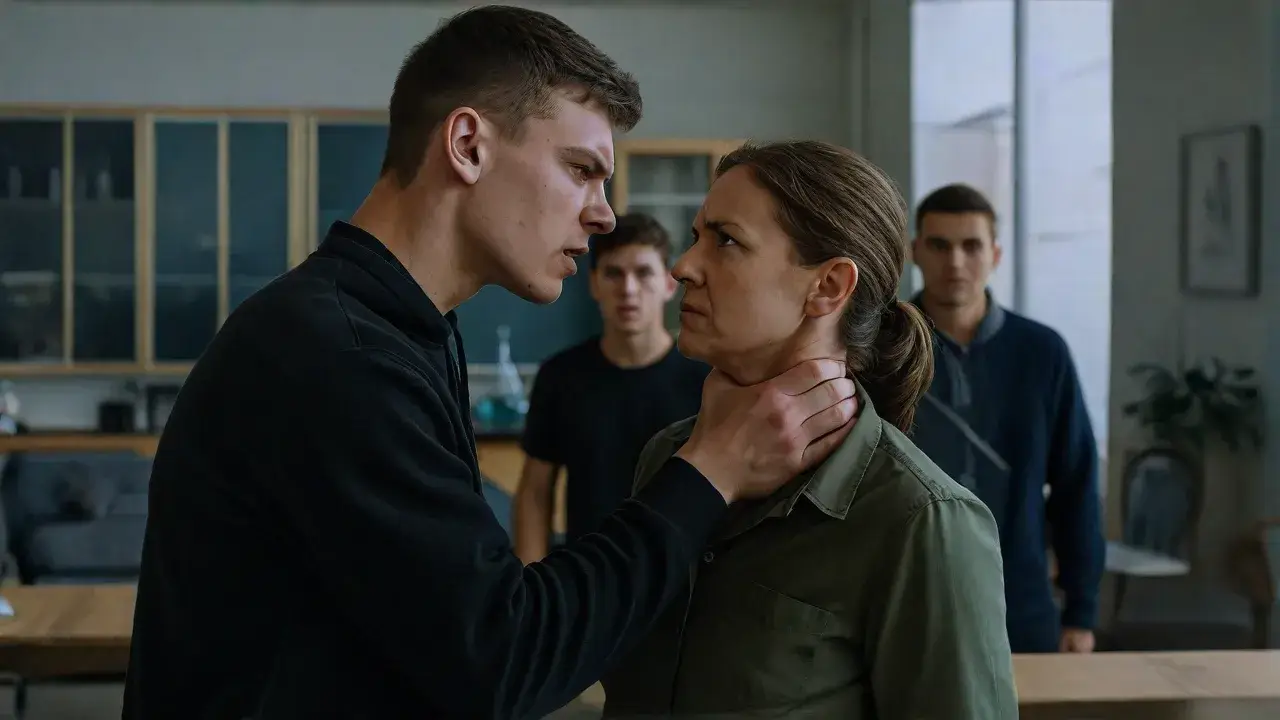
Marine Captain Fights ER Staff Until a Nurse With a Secret Combat Past Reveals Their Shared Connection
«I saw Carter,» she said quietly. «When the first blast hit, he pushed me. I do not remember hitting the floor. I remember the sound when the beam came down.»
Noah’s eyes darkened; he did not interrupt.
«Russ ordered me out,» she continued. «He got between me and the hallway. I grabbed Mills. You were already half-conscious, trying to get up. There were too many people and not enough door.»
Her throat tightened, but the words kept coming, pulled along by a tide that had waited years for an outlet.
«I have replayed that stairwell so many times, I can feel each step under my feet,» she said. «How many breaths I took between the top and the bottom. How many seconds were between the last time I heard Russ’s voice and the moment the building folded.» Her voice dropped. «If I had been faster. Stronger. Better. Maybe…»
«Stop,» Noah said. It was not sharp; it was firm. «You know that speech,» he added. «You have aimed it at yourself more times than you can count. The part where you rewrite physics to pretend you could hold up a building.»
She looked at him. «Do you not?» she asked.
«Of course I do,» he said. «But I usually save it for three in the morning when there is no one around to listen.»
He shifted his hand again, this time letting his fingers brush the metal near her knuckles. It was not a full touch, but it was aligned.
«Cole said they reviewed the After Action,» Noah said. «Said the last thing Russ did was shove you toward the exit and hold his ground.» He swallowed. «That sounds like him,» he said. «He made you move so you could drag the rest of us out. That is not you failing. That is him doing the math.»
Grace let the words land. They hit something that had been locked and twisted inside her, something that resisted, and then gave way just a fraction.
«Does it make it easier?» she asked.
«No,» he said. «It makes it different.»
They let the quiet stretch after that. The monitor beeped in steady intervals. A pump clicked. Somewhere outside in the city, a siren wailed and then faded.
«Lucy will be back in a minute to kick me out,» Grace said eventually.
«So,» Noah said, «you better use your remaining time.»
«For what?» she asked.
He looked at her hand on the rail. «For not disappearing,» he said.
She hesitated, then slid her fingers down, closing them lightly around his wrist over the IV tape and the faint pattern of pulse beneath. The contact was warm, solid, very human.
«I am here,» she said.
«You said that before,» he replied.
«I mean it more now,» she said.
He let his eyes close fully at last, the muscles in his face smoothing. «Doc Holloway,» he murmured. The name sounded softer, no longer a shock, more like a confirmation.
«Grace,» she corrected gently.
He did not answer. His breathing slipped into something deeper. The lines on the monitor stayed steady.
The door opened with a soft click. Lucy poked her head in. «Time,» she said quietly.
Grace nodded and carefully let go of Noah’s wrist. Her hand felt oddly light afterward, as if she had been holding more than bone and skin. She stepped back from the bed.
«How is he?» Lucy asked.
«Stubborn,» Grace said.
Lucy smiled. «That is usually a good sign up here,» she said.
Grace glanced at him one last time, at the way the bandages rose and fell with each breath, then stepped out into the hallway. On the way back to the elevators, she passed a window that looked out over Houston. The streets below glistened from the earlier rain. The storm had moved on, leaving the air clearer, the sky still dark but less heavy.
Her reflection hovered in the glass, overlaying the scattered lights. Scrubs, badge, tired eyes. For a second, she thought she could almost see another version of herself standing behind the first. Helmet, vest, dust on her cheeks. They did not cancel each other out.
She turned away and pressed the elevator button. There was still a shift to finish. There were still patients who knew nothing about Nightglass, who only knew the weight of their own emergencies. As the doors slid open, she slipped out back inside the moving box of light, heading down toward the noise and the board and the work that had always been her way of staying in motion.
The elevator let her out back into the familiar chaos of the ER. The sounds felt louder after the hush of the ICU. Someone argued about insurance at the registration desk. A toddler howled somewhere behind Pediatrics. A paramedic laughed too hard at a joke, the sound edged with leftover adrenaline.
Grace slid behind the nurse’s station and checked the board. New names had appeared. Cuts, sprains, a possible appendicitis—the ordinary, steady river of small disasters. She folded herself back into it. For a while, there was only work. Blood pressures to take, meds to pass, a chart that refused to print properly. Her hands moved on their own, drawing on habits built over months here and years elsewhere.
At some point, as she was double-checking a dosage at the computer, she felt it again. That subtle prickle at the back of her neck, the sense of someone watching who knew more than the average visitor. She finished entering the order before she looked up.
Cole Everett leaned against the far corner of the station, a chart in his hand. He had traded his suit jacket for a dark cardigan, but the badge at his belt had not changed. The effect was strange—less formal, not softer.
«You really do work, do you not?» he said.
«Some people pretend not to notice,» she replied.
«I was briefed on the difference between civilian nursing and combat medicine,» he said. «No one mentioned paperwork was the common thread.»
She closed the chart. «Are you here for him,» she asked, «or for me?»
«Both,» he said. «Not at the same time.»
Marta walked up, glanced between them, and made a quick adjustment to the whiteboard that did not seem to need adjusting. «I’m going to check on Bed Five,» she said, a shade too casually. «Take your time, Holloway.»
Then she left, the swish of her sneakers fading down the hall. Cole raised his eyebrows a fraction.
«You have friends,» he observed.
«I have co-workers,» she said.
«Some would argue there is overlap,» he replied. He looked around at the station. «Do you have anywhere that passes for private in this place?» he asked. «Or at least less public?»
«Break room,» she said. «If no one is crying in there.»
They walked together down a short side hallway. The break room was small, with two tables, a fridge that hummed constantly, and a microwave with a door that stuck. A faded poster about hand hygiene peeled slightly at one corner. It was empty. Grace flicked on the light. It buzzed for a second before settling.
Cole set a thin folder on the table and took the chair opposite hers. He placed the folder lengthwise, as if aligning it with invisible lines on the surface.
«I promised you a conversation,» he said.
«You promised me more context,» she replied.
«Same thing,» he said. He tapped the folder once with two fingers. «This is the After Action Summary for Operation Nightglass,» he said. «The one you never read.»
Grace pulled out a chair and sat. Her knees brushed the underside of the table. «They told me everything I needed to know when I signed my discharge,» she said.
«Did they?» he asked.
«They told me I was found with blast injuries and multiple concussions,» she said. «They told me the building collapsed. They told me I was lucky to be alive.»
«Lucky is a generous word,» Cole said.
«They told me the team took heavy losses,» she added. «Which I already knew.»
He opened the folder. Inside was not much. A few pages clipped together. Some lines were blacked out. Others remained neat print that turned chaos into bullet points and short sentences. He slid the top page between them.
«You know what it felt like,» he said. «This is what it looked like on the other side.»
She looked down at the paper. Her name was there in the list of personnel. So were the others: Reddick, Carter, Mills, Reyes, Russ. Her eyes skipped ahead.
Contact initiated at target structure. First detonation. Structural compromise, upper levels. Evacuation ordered. Second detonation, stairwell collapse.
She felt her pulse pick up in her throat.
«Carter,» she said.
Cole took that as a cue and turned a page. There it was.
Carter, R. — KIA. Caused structural impact during initial blast, upper corridor. Body unrecovered due to instability of site.
Her vision narrowed for a moment. The words blurred, then sharpened. She swallowed.
«Russ?» she asked.
Cole flipped further. He tapped a paragraph halfway down.
Corpsman Holloway ordered to withdraw injured personnel from upper level, he read. Sergeant Russell remained in position to cover retreat. Held corridor against advancing hostiles until third detonation.
He paused. «Quotes from surviving witnesses,» he said. «That part was unusual. They do not always include them.»
He turned the page so she could see it better. A section near the bottom held lines in a different font, like someone had pasted pieces of other reports into this one. He read the first aloud.
«Last seen, Sergeant Russell physically pushed HM2 Holloway toward exit,» Cole read. «Verbal order recorded on comms: ‘That is an order. Move.’«
The words echoed her own memory. Same cadence, same emphasis. Cole looked up.
«You told me you heard him say something like that,» he said.
She nodded once, stiffly. «I heard him,» she said. «I just decided it was the wrong choice.»
Cole exhaled softly. «From his side, it looks different,» he said. He read the next quote.
«Without Holloway moving, Sergeant Reddick and Mills do not clear the structure before collapse,» he recited. «Multiple survivors credit Holloway with dragging them past last stable wall.«
The room seemed smaller for a moment, the walls closer. Grace stared at the words.
«‘Dragged’ is a very generous verb,» she said quietly. «There was a lot of stumbling.»
«The floor did not file a complaint,» Cole said.
He let the silence sit, not rushing to fill it. Grace traced a line along the edge of the paper with one finger, careful not to touch the blacked-out sections.
«What are you trying to do?» she asked finally. «Prove that a report can make it sound clean?»
«No,» he said. «I’m trying to make sure you know the version that made it into the archive is not the one where you failed everyone.»
She looked up at him.
«In their version, Grace,» he continued, «you followed a direct order under impossible conditions and got as many people out as physics allowed. You did not abandon anyone. You did not decide who lived.»
«I left him,» she said.
«No,» Cole said. «He chose to stay.»
«He did not get to live with that choice,» she said.
«That is true,» he replied. «You did. Which is why you twisted it until it sat on your chest instead of his.»
Her jaw clenched. «You sound very sure,» she said.
«I read a lot of reports,» he answered. «I listened to how people talk about themselves in the years afterward. There are patterns.» He folded his hands on the table, fingers lacing. «One pattern is this,» he said. «The people who had no choices blame themselves the most. The ones who had plenty sometimes blame everyone else.»
«Which one am I?» she asked.
«You had one choice,» he said. «Stay and die in a hallway that was already coming down, or move and try to keep a pulse in anyone you could reach.» He inclined his head toward the paper. «The record says you chose option two,» he said.
She let out a breath that trembled slightly at the end. «And you?» she asked. «What did you choose?»
«In that office,» he said, «I chose an office three buildings away in a country with central heating.» His voice held no pride in that, no shame either, just fact. «I was not there,» he said. «I saw it through feeds and transcripts, which is exactly why I keep the words from the people who were.»
He tapped the quote again. «He ordered you out,» Cole said. «He did the math in his head that you keep doing in yours, and he put himself on the side of the equation he knew he was not walking away from.» He leaned back slightly. «You do not have to like that,» he added. «You just have to recognize that you did not overwrite his choice.»
Grace sat very still. Something inside her had the sensation of a door that had been barred for a long time. The wood had warped around the lock. The hinges had rusted. Now, under repeated pressure from both sides, it creaked—not quite open, but no longer sealed.
«He died,» she said.
«Yes,» Cole said.
«They nearly did,» she added. «Noah, Mills, Reyes.»
«And they did not,» Cole said, «because you moved.»
She looked back down at the paper at her own name. Holloway, Grace M. Status: SURVIVED. The line had been corrected recently. A note in the margin marked the change from Presumed KIA to Present. Fresh ink over old assumption. She noticed another annotation, a small star next to her name.
«What is that?» she asked.
Cole followed her gaze. «Anchor,» he said.
The word sat heavy. «You used it in the hall,» she said. «You said people pay attention to their anchors.»
He nodded. «In messy operations,» he said, «certain individuals become points we tie our understanding to. You pull six people out of a collapse, you become one of those.»
«That does not obligate me to be anything now,» she said.
«No,» he said. «It does not obligate you. It does explain why your reappearance has people above my desk rearranging their expectations.»
She closed the folder and pushed it back toward him. «So that is what this is,» she said.
«Expectations is acknowledgment,» he said. «And yes, expectation.» He let that land without dressing it up. «You have options,» he said, «more than you think.»
«Such as?» she asked.
«You can stay exactly where you are,» he said. «Work your shifts, take care of sprains and crash codes, go home, sleep, repeat. No one is going to drag you back into a uniform by force.» He set his hand lightly on the folder. «Or,» he said, «you can let us formally recognize what you clearly still carry.»
She frowned. «Recognize how?» she asked.
«Advisory roles,» he said. «Training. Tactical medicine instruction. You already did half a workshop in that CT suite.»
She thought of Jamie, eyes wide as he watched her push the needle into Noah’s chest, of Lang’s reluctant nod.
«We have young teams rotating through scenarios based on reports like this one,» Cole continued, tapping the folder. «They learn from sanitized versions. You could help unsanitize them. Make them real without putting yourself on a plane.»
The idea settled in the air between them. Not sharp, not soft. Heavy. She pictured a room of trainees, mannequins on tables, whiteboards with diagrams. Her voice explaining patterns of blast and pressure and how to tell when a patient was drowning from the inside. Her stomach fluttered.
«I still work here,» she said.
«You can do both,» he said. «Or neither. I am not a recruiter; I am a messenger.»
«You brought me a file and a status I did not ask for,» she said.
«And I’m telling you what some people hope you might be willing to do with them,» he replied. He spread his hands slightly. «You get to decide,» he said. «That is more than some people got.»
That last sentence sat in the room like a stone. She thought of Carter, of Russ, of nights in sand and concrete. Of Noah in the ICU, breathing under soft light, of the hiss of air leaving his chest through a needle. Her fingers flexed on the edge of the table.
«What if I say no?» she asked.
«Then we adjust our maps,» he said. «And you go back to your board and your patients and your life.»
«What if I say yes?» she asked.
«Then we schedule conversations in smaller rooms than this one,» he said. «With people who have more paperwork than I did.»