The General Was Left Behind on Christmas Eve: The Legend of the Golden Rifle Rescue
Christmas Eve smothered the dead city in ash and snow. In a basement cell, the Army General counted breaths while rebels broke him for names that didn’t exist. Radios hissed with prayers. Outside, ruins echoed with bells from a church without walls.
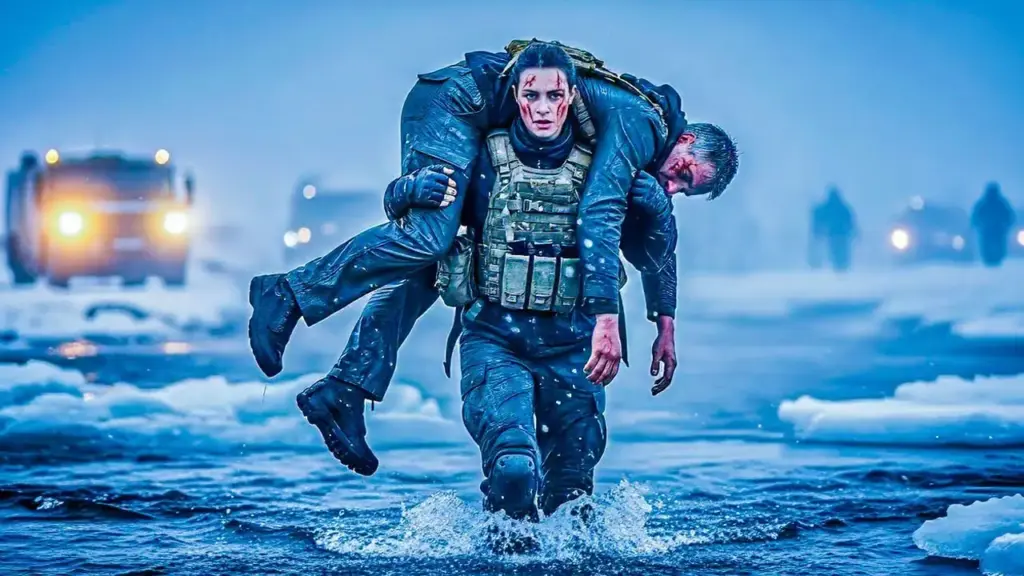
Then, the river rippled. A woman rose from the black water, ice sliding from her cloak. A golden rifle was cradled in her arms like a promise. She didn’t run; she listened to the wind, the distance, and the guilt.
One shot erased a commander. Another cut the lights. In the silence, hope learned to breathe again. Christmas bells stopped, and the city waited for mercy tonight alone. The city had no name anymore. Maps called it Riverside, but locals called it nothing. They were gone.
Snow mixed with ash fell on buildings that leaned like broken teeth. Christmas lights still blinked in third-floor windows where no one lived—red, green, white. They ran on generators that coughed diesel smoke into the frozen air. The rebels kept them running; they wanted the city to look alive when the cameras came.
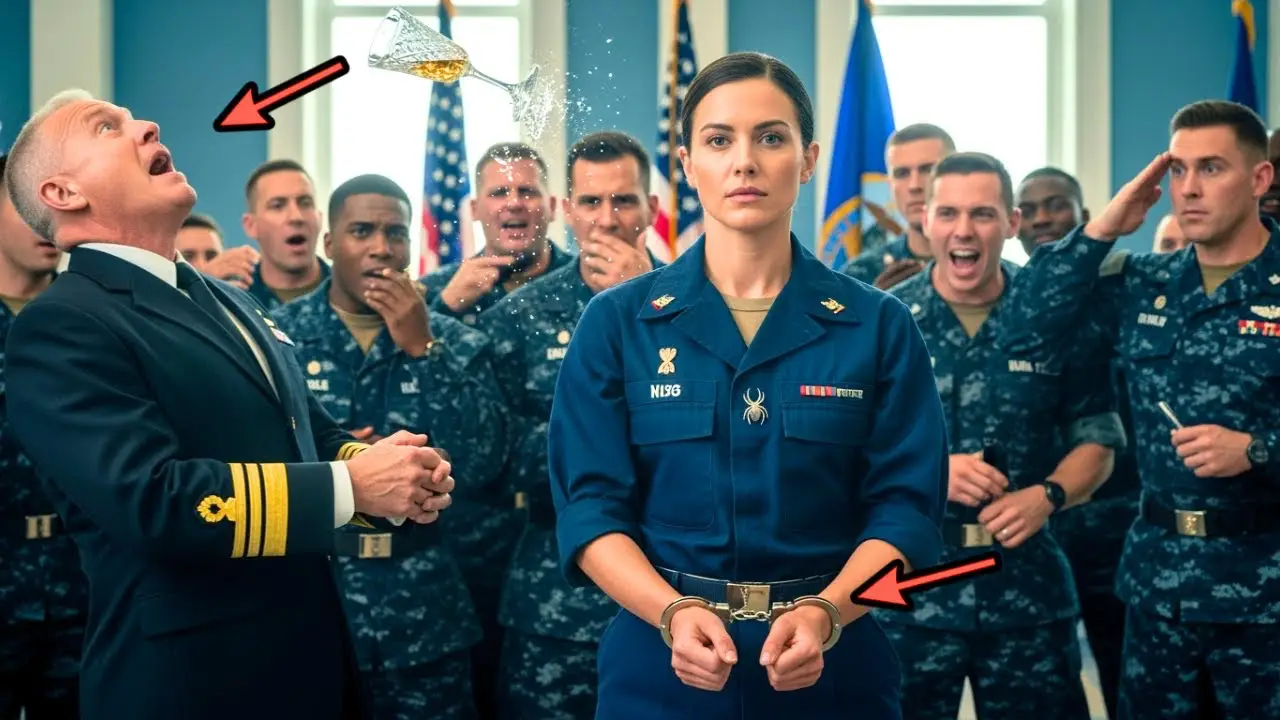
General Nathan Calloway had tried to stop this three months ago. He brought food convoys, medical supplies, and unarmed negotiators in white vests. The rebels took the supplies and shot the negotiators. Then, they took the general. That was fourteen days ago. Now, the city belonged to them.
Commander Victor Strand and his Revolutionary Brigade controlled the high-rises. They had anti-aircraft guns on the rooftops, mortars in the parking garages, and machine-gun nests where families used to eat breakfast. They painted their flag on every wall: a broken chain wrapped around a fist.
The military tried to get Calloway back. First came the drones, but Strand’s men shot them down with shoulder-fired missiles. Then came the helicopters at night; they lost two Blackhawks to RPGs before pulling back. Then came Delta Force operators who rappelled from the roofs. Only one made it out. He said the general was alive, still talking, still refusing to break. That was four days ago.
By Christmas Eve, command had stopped trying. The dead city was a graveyard for rescue attempts, and every soldier sent in became another name on the casualty list. Every helicopter became scrap metal.
The Joint Chiefs held a conference call and agreed: Calloway was lost. They would negotiate after the holiday, maybe trade prisoners, or maybe just wait until the rebels executed him on camera. They sent the message at 1800 hours: «Stand down. No further rescue operations authorized.»
The message never reached everyone. In his cell, Calloway sat on concrete. His left eye was swollen shut, three ribs were cracked, and his uniform was gone. They gave him prison grays that smelled like gasoline.
The cell was ten feet by eight feet, with no windows, one door, and one bulb that never turned off. They came every six hours—four men. They asked questions Calloway couldn’t answer even if he wanted to: names of undercover agents who didn’t exist, locations of weapons caches that were never built, passwords to systems he had never seen.
When he said nothing, they hit him. When he still said nothing, they brought the bucket. Waterboarding had a clinical sound, but in reality, it was drowning that stopped just before death. Calloway had been through SERE training. He knew the physiology: the brain panics, the body convulses, the mind breaks into pieces and forgets how to reassemble.
But he didn’t break. Not because he was strong, but because there was nothing to give them.
Commander Strand visited on Christmas Eve. He came alone, with no guards and no questions. He sat on a metal stool and lit a cigarette.
«You know what happens tomorrow, General?»
Calloway said nothing.
«We take you outside. Put you in front of a camera. You read a statement. You say the government abandoned its people. You say the military is corrupt. You apologize for your crimes.»
Strand exhaled smoke. «Then, we let you go.»
«I don’t believe you,» Calloway replied. «Smart man.»
Strand smiled. «We shoot you after the broadcast. But we let you write a letter first. To your daughter. Rachel, yes? She’s thirteen. Plays soccer. Lives with your ex-wife in Maryland.»
Calloway’s jaw tightened.
«Don’t worry,» Strand said. «We won’t hurt her. We just want you to know we could.»
He stood, dropped the cigarette, and ground it under his boot. «Tomorrow morning. 6 AM. Merry Christmas, General.»
The door closed, and the lock clicked. Calloway put his head against the wall. His radio was gone, his phone was gone, and his men were gone. He was alone.
Outside the cell, the city waited. Snow piled on the streets, and wind moved through broken windows. In a plaza two blocks away, a Christmas tree still stood. Someone had decorated it in October, before the siege. Now, the ornaments hung from bare branches like forgotten promises.
The rebels patrolled in threes. They wore mismatched uniforms: Russian vests, American helmets, Chinese rifles. They were farmers, factory workers, and college students who believed the revolution would fix everything the government broke. They were wrong, but they believed it hard enough to kill.
Strand’s command post sat on the eighth floor of what used to be City Hall. He had twenty men there, along with radios, maps, and surveillance feeds from cameras planted throughout the ruins. He watched everything and controlled everything. Except the river.
The river moved through the city like a black vein. It was frozen on the surface, but underneath, the current still flowed. The rebels didn’t patrol it, nor did they mine it. They assumed no one was stupid enough to use it. They were wrong.
At 2100 hours, the river rippled near the South Bridge. Something moved beneath the ice. Not a fish, not debris—a hand. Fingers gripped the edge of a broken pier. A shape pulled itself from the water: black wetsuit, black rebreather, black hood that covered everything except the eyes.
The figure crouched on the pier, listened, and waited. Then, she reached back into the water and pulled up a waterproof case. Inside the case was a rifle. Not black, not gray, but gold. The city didn’t know it yet, but the hunter had arrived.
The cold woke Calloway. Not the cold of the cell, but the cold inside him. He had felt it before—Afghanistan, 2009. Ambushed in a valley with no air support, watching his men die one by one while he radioed for help that never came. He survived because a 19-year-old private threw himself on a grenade.
The cold started then. It was the knowledge that survival sometimes meant watching better people die. Now, the cold was back. He counted his breaths. Inhale for four, hold for four, exhale for four. SERE instructors taught him that: control your breathing, control your fear, control your mind.
But his mind kept slipping. Rachel, thirteen years old. The last time he saw her was in September. She showed him her report card—all A’s except for English. She hated reading but loved math and wanted to be an engineer. He told her he was proud. He told her he’d be home for Thanksgiving. He lied.
The mission came up: a three-week deployment to establish a humanitarian corridor through contested territory. It was supposed to be an easy job, a safe job, a photo op for politicians. Calloway needed the promotion to three stars. Win-win. Except nothing about war was ever easy or safe.
The door opened. Calloway didn’t look up. He counted the footsteps. Four men, same as always.
«Stand up, General.»
He stood slowly. His ribs screamed, and his left knee barely held his weight. The rebels had worked him over carefully—nothing permanent, nothing that wouldn’t heal. They wanted him presentable for the camera.
The leader was a man called Gregor. Thick neck, scarred knuckles, former boxer. He spoke English with a Moscow accent that didn’t match his face.
«You ready to talk?»
«I have nothing to say.»
Gregor nodded to the others. They moved fast, grabbed Calloway’s arms, forced him into the chair, and strapped his wrists to the armrests. The bucket came next.
Calloway closed his eyes, trying to find that place in his mind where the pain couldn’t reach. The instructors said it existed—a room inside yourself where you could hide. He never found it. The water hit his face like a wall, blocked his nose, blocked his throat. His lungs burned. His body thrashed against the straps. The world became a roaring nothing.
Then it stopped. He gasped, choked, and vomited water.
«You have names,» Gregor said. «Agents embedded in our territory. Give us three names. We let you rest.»
Calloway said nothing. There were no agents. Command didn’t embed people in rebel territory anymore—too risky, too expensive. This was all theater. Gregor knew it, Calloway knew it, but the theater continued.
The water came again. And again. And again. After the fourth time, Gregor pulled up a stool, sat close, and spoke quietly.
«You think you’re protecting something, General. Your honor. Your country. Your daughter’s memory of you.»
He lit a cigarette and offered it. Calloway didn’t take it.
«But no one is coming for you. You understand this, yes?»
Calloway met his eyes. «They’ll come.»
«Who? Your Delta Force? We killed them. Your helicopters? We shot them down. Your government? They already wrote you off.»
Gregor stood. «You’re a ghost. A casualty report. A regret in some politician’s speech.»
He walked to the door and turned back. «Tomorrow, you die. But tonight, you can choose how. Dignity or drowning. Camera or bucket.» He shrugged. «Your choice, General.»
The door closed. Calloway sat alone. Water dripped from his hair. His chest ached, and his throat burned. He thought about Rachel again, wondering what they told her. Probably nothing. «Classified mission. Can’t discuss details.» She was used to it. Military families learn to live with silence. But this silence was different. This was the permanent kind.
His mind drifted. He saw faces. Men he’d commanded, men he’d buried. Private Chen who took the grenade. Lieutenant Kowalski who bled out in his arms. Sergeant Davis who stepped on a mine. All of them gone. All of them younger than his daughter would ever be. He whispered into the empty cell: «Send help.» The words felt stupid, desperate, like a child’s prayer. But he said them anyway.
Three floors above, in the command center, Strand studied his maps. The execution site was marked in red: the plaza with the Christmas tree. He’d set up cameras there—three angles, good lighting. The broadcast would go live at dawn. Every network would carry it. The world would watch.
«Commander,» one of his men said. «Radio check complete. All posts reporting.»
«Good.»
Strand traced a line on the map. The perimeter. Twenty checkpoints. Forty men rotating shifts. «No one gets in. No one gets out.»
He felt confident. Secure. He didn’t know the river had already been crossed. He didn’t know the hunter was inside his city. He didn’t know the golden rifle was being assembled in the ruins of a church. He didn’t know Christmas Eve was about to become something other than a celebration.
Outside, snow continued to fall. The city held its breath. And in the darkness, something moved.
Her name was classified. Her rank was classified. Her existence was classified. Official records listed her as KIA—Killed in Action, January 2019, during a black operation in Eastern Europe. Closed casket funeral. Military honors. Folded flag presented to her mother. The army filed the paperwork, and the case was closed.
But she wasn’t dead. She was something else now. Something without a file, without orders, without a chain of command. The soldiers who knew her called her Winter. Not because of her personality, but because of when she worked: cold months, long nights, targets that needed to disappear when the world wasn’t watching.
The golden rifle was older than her career. It started as a standard M110, Army issue, semi-automatic, 7.62 NATO. Effective range: 800 meters. She’d carried it through twelve deployments. Then came the mission that killed her officially.
A warlord in the Balkans was using chemical weapons on civilian targets. The UN debated sanctions; the army sent Winter. She took the shot from 1,400 meters. Wind was 12 knots, temperature was minus 8 Celsius. The bullet traveled for three seconds before it found the target. One shot.
No witnesses. No proof. Except the warlord’s men found the shell casing, traced it, followed it, and hunted her across two countries. She barely made it out. Lost her spotter. Lost her radio. Lost everything except the rifle.
When she finally reached friendly territory, command made a decision. The mission was too dirty, too illegal, too complicated. Easier to bury it—bury her. They offered her a deal: take the death certificate, take the discharge, disappear. She took it.
For three years, she lived quietly in Montana. Small cabin. No neighbors. No phone. She hunted deer, fixed her roof, and tried to sleep without dreaming. But the rifle stayed in her closet. And the dreams never stopped.
Then came the transmission. Christmas Eve, 1600 hours. She was splitting firewood when her old radio crackled—the one she should have destroyed, the one she kept anyway. The signal was weak and broken, but she heard enough. «General Calloway. Captured. Dead city. No rescue authorized.»
She stood there, axe in hand, snow falling on wood half-split. She knew Calloway. Everyone in special operations knew him. He’d been a major when she was a private. He’d signed off on her sniper school application when others said women couldn’t handle the course. She never met him personally, never shook his hand, but she owed him.
The transmission repeated. She listened three times, memorizing the coordinates. Then, she went inside. The rifle case was covered in dust. She opened it. The weapon gleamed. Someone had gold-plated it as a joke during her last deployment—a gag gift from her unit. She’d kept it. Not because it was funny, but because it reminded her of the people she’d lost.
She cleaned the rifle, checked the scope, and loaded the magazines. Then she called a number she wasn’t supposed to have. Logistics.
«This is Winter. I need transport to Riverside.»
Silence followed. Then, «That designation is inactive.»
«I’m activating it.»
«No authority. No authorization.»
«No. Calloway is alive. I’m going in.»
More silence. «Transport leaves in two hours. Peterson Air Base. Don’t be late.»
The line went dead. She packed light: wetsuit, rebreather, ammunition, thermal scope, first aid. She left everything else—pictures, clothes, the life she’d built. She didn’t plan to come back.
The flight took six hours in a military cargo plane—no windows, no questions. The pilot dropped her 20 kilometers from the city. Parachute insertion. Night jump. She landed in a frozen field and walked.
The city appeared at 2000 hours. Smoke and snow, ruins and shadows. She could see the checkpoints from two kilometers out. Rebel positions were marked by generator lights, thermal signatures, and predictable patterns. She circled south and found the river. The current was faster than she expected, and the ice was thicker.
She put on the wetsuit, attached the rifle case to her back, and entered the water. The cold hit like a hammer. Her body wanted to seize, to panic. She controlled her breathing, kicked against the current, and swam beneath the ice. The city looked different from underwater; buildings were shadows, lights were ghosts.
She surfaced once to orient, then dove again. Fifteen minutes later, her body was shutting down, hypothermia creeping in. She saw the pier, the broken dock. She kicked hard. Her hand found concrete. She pulled herself up, lay on the pier, and breathed.
Then she heard voices. Two rebels, thirty meters away, patrolling the waterfront. They spoke Russian, complaining about the cold, about Christmas duty, about Strand’s paranoia. Winter didn’t move. She didn’t breathe. She became part of the darkness. The rebels passed, and their footsteps faded.
She opened the rifle case, assembled the weapon, and checked the chamber. The gold finish caught the moonlight, so she covered it with a black cloth. Above her, the city spread out like a corpse. Command post eight blocks north. Execution plaza four blocks east. Calloway’s cell somewhere in between.