«If You Can Open This Safe, I’ll Marry You,» Smirked the CEO — What He Found Inside Left Her in Tears
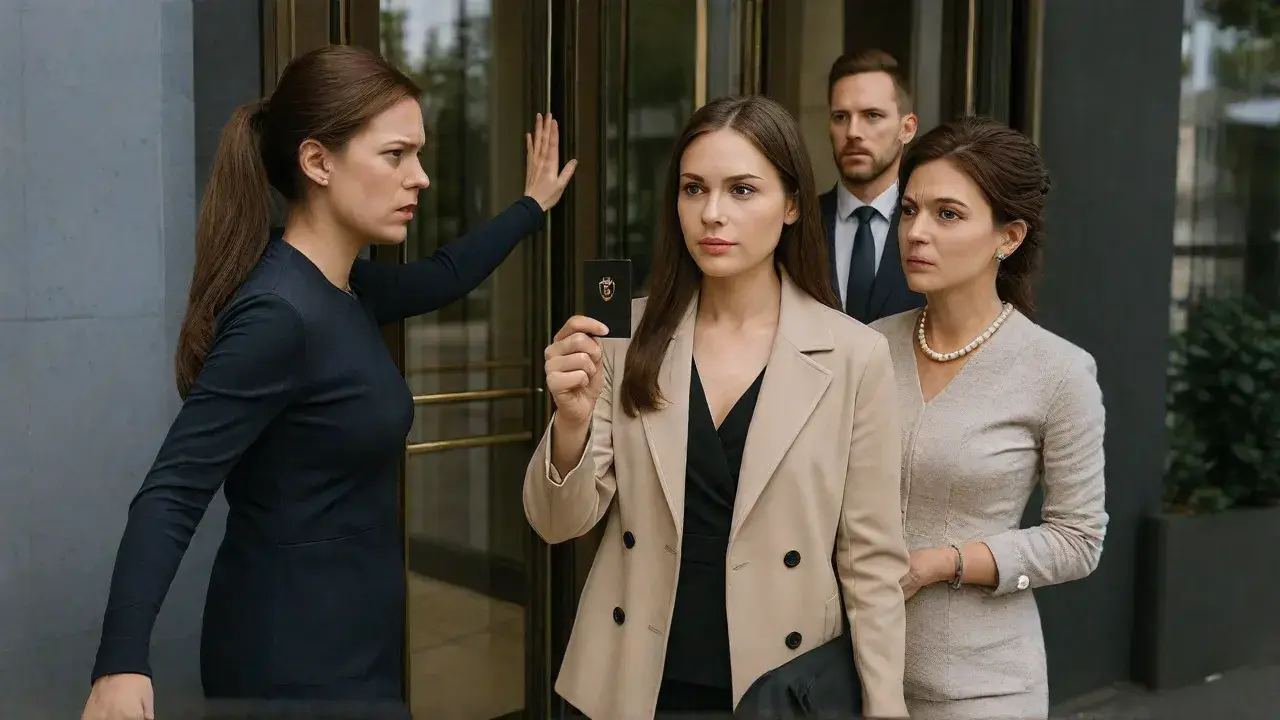
«If you can open this safe, I’ll marry you.» Audra Langdon didn’t look up from the tablet in her hand when she said it. The words were flint, sharp and dismissive, aimed at no one and everyone. Her heels clicked a nervous rhythm on the polished concrete floor of her penthouse office, a stark counterpoint to the city’s silent panorama glittering fifty stories below. The safe, a hulking black monster of riveted steel and brass, sat against the far wall like a tombstone. It was the only thing in the room older than her father’s ambition, a stubborn relic in her world of glass and light-speed data.
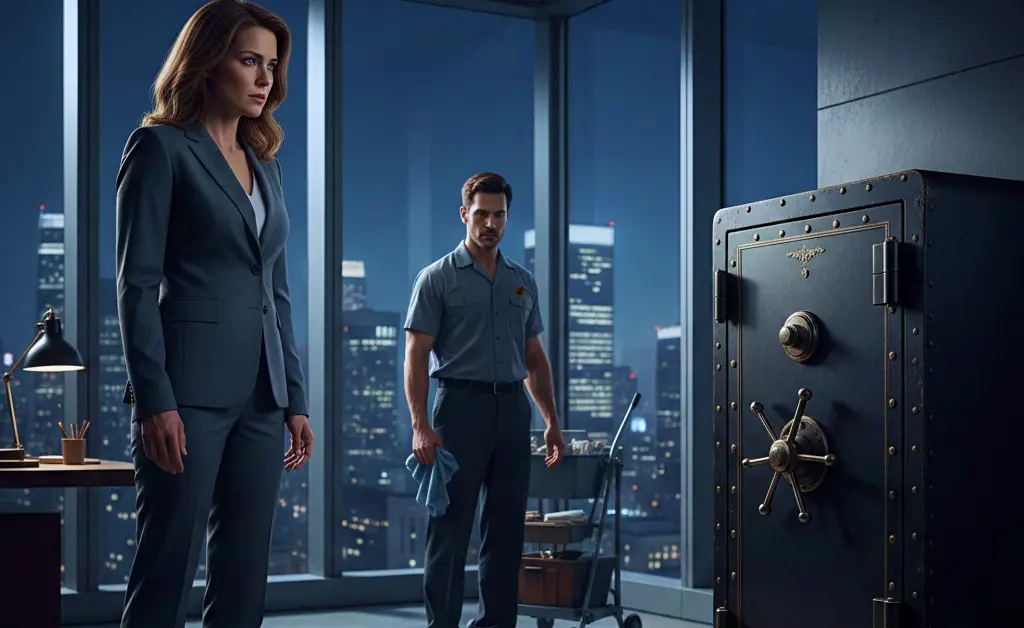
The janitor, a man with shoulders broad enough to carry secrets, paused his work. He was wiping down the base of the safe with a focused calm that seemed almost defiant in the tense air. He didn’t look at her, but she felt his stillness cut through her frustration.
She finally glanced up, her patience worn thin by a day of failed engineers and condescending smirks from her board.
«Did you hear me?»
The man looked at her then. His eyes were a deep, steady brown, clear and unreadable. He rose slowly from his crouch, the cleaning cloth held loosely in one hand.
«I heard you, Ms. Langdon,» he said, his voice even, without a trace of the subservience she was used to. «But a lock like that doesn’t open because someone dares it to. It opens because someone understands it.»
Audra arched an eyebrow, a flicker of surprise crossing her face. «So, you’re an expert on antique safes now?»
He didn’t answer, just returned to his task, folding the cloth in his palm with a quiet, deliberate precision. Audra watched him for a beat too long, then let out a short, humorless laugh.
«Right, didn’t think so.»
She turned on her heel, the moment over. She didn’t know why she’d said it. Maybe it was the pressure from Leland, the smug chairman who had all but told her she wasn’t fit to run her own company. Maybe it was the sheer insolence of the safe itself, a final problem her father had left behind that she couldn’t solve with money or power.
Or maybe it was the way the janitor had looked at it, not as a piece of furniture to be dusted, but as a puzzle to be respected. Whatever it was, it was done. She strode to her desk, swiped a file into her briefcase, and headed for the private elevator, disappearing into the throat of the empire she commanded but couldn’t quite control.
By the time Penn Calder finished his shift, the building had settled into the deep, humming sleep of a machine at rest. He stood for a long moment in the empty office, the scent of citrus cleaner and Audra Langdon’s expensive perfume still hanging in the air. He looked around once at the sprawling desk, the glowing screens, the city laid out like a carpet of jewels.
Then, his eyes returned to the safe. He walked over to it, not as a janitor, but as something else entirely. He knelt, his posture changing, his focus sharpening. He didn’t touch the dial; he didn’t try the handle. He simply placed the palm of his hand flat against the cold steel of the door, closed his eyes, and listened.
To what, he wasn’t sure. The settling of the building, the ghost of a memory, the faint, internal sigh of tumblers that hadn’t turned in a decade.
A lock like that, his wife used to say, has a heartbeat. You just have to be quiet enough to hear it.
He stayed there for a minute, maybe two, lost in a silence shaped like a life he no longer lived. Then he stood, gathered his cart, and left, the massive safe standing guard over its secrets.
The next morning, Audra’s assistant, a perpetually frazzled young man named Ian, placed a steaming coffee on her desk and launched into a litany of the day’s disasters.
«Leland has moved the quarterly review up to Friday. The schematics from Berlin are corrupted, and someone from Forbes is asking for a comment on the rumor that our Q3 projections are creative.»
But Audra wasn’t listening. Her gaze was fixed on the floor beside the safe. There, almost hidden in the shadow, was a small, folded piece of paper. It looked like a discarded napkin. She waved Ian into silence, crossed the room, and picked it up.
«Ms. Langdon?» Ian asked.
She unfolded it. It wasn’t a note; there were no words. It was a drawing executed with the stunning precision of a master draftsman. It showed a single, incredibly complex component of a lock mechanism: a sidebar with a unique serrated edge.
And next to it, a tiny, almost invisible arrow pointed to a single point on one of the serrations, with a number beside it: 0.02 millimeters. It wasn’t a suggestion; it was a diagnosis, the subtlest of misalignments. It was the kind of flaw her high-paid engineers, with all their laser scanners and digital modeling, had missed completely.
The kind of flaw you could only find by touch, by feel, by listening for a heartbeat. Audra stared at the drawing, her own heart suddenly beating a little faster. She looked from the perfect lines on the cheap paper to the immovable steel door of the safe, then out into the empty hallway.
The janitor. The man with the quiet hands and the steady eyes.
«Ian,» she said, her voice low and sharp. «Get me the personnel file for the overnight janitor, the third shift. Now.»
Ian blinked, his face a mask of polite confusion. «The janitor’s file? Ms. Langdon, is there a problem with the cleaning service?»
«Just get it, Ian,» she said, her voice dangerously quiet. She didn’t take her eyes off the hand-drawn schematic in her fingers. It was drawn on a cheap, disposable napkin, but the lines were more confident and precise than anything her six-figure engineering team had produced in a week.
He scurried away. Audra walked back to her desk, the napkin held as if it were evidence. She spread it flat, the intricate drawing a stark analog island on the sleek black surface of her desk. It was a challenge, a whisper in a world where she was used to shouts.
Minutes later, Ian returned, holding a single flimsy manila folder as if it were contaminated. He placed it gingerly on her desk.
«Penn Calder. Started six months ago, clean record.»
Audra snatched the file; it was insultingly thin. Inside, there was a one-page application form, a copy of a driver’s license, and a W-4. The photo showed the man from last night: strong jaw, calm eyes that seemed to hold more space than they should. Under work history, there were only two entries: a warehouse job in the industrial district and a maintenance position at a downtown hotel.
It was the resume of a ghost, a man deliberately leaving no tracks. No education, no special skills listed, nothing. She slammed the folder shut. It made no sense.
A man with this level of mechanical intuition, this drafting skill, was scrubbing floors? It wasn’t just improbable; it was impossible. People didn’t hide genius like this unless they were running from something.
A new kind of energy sparked through her. Not frustration, but a hunter’s curiosity. She couldn’t just call him in and interrogate him. A man this careful would simply deny everything, retreating deeper into his shell. No, she had to continue the conversation he had started. She had to bait the trap.
That evening, before she left, Audra walked over to a low credenza that housed her father’s old collection of engineering texts. She pulled out a thick, leather-bound volume: Fletcher’s Treatise on Lever and Tumbler Mechanisms. It was an obscure, almost legendary text among lock designers.
She opened it to a chapter detailing the Cerberus, a notoriously complex, triple-redundant lock her father had been obsessed with but had never managed to replicate. She left the book open on the small table beside the safe, a bottle of cleaning spray and a cloth placed neatly beside it, as if a janitor had been interrupted mid-task. It was a question disguised as an oversight.
The door to Penn Calder’s apartment opened into a life that was meticulously managed. It was a small, clean space that smelled faintly of laundry soap and the cinnamon toast his daughter, Willa, loved. Framed pictures she had drawn of smiling suns and lopsided cats were the only decorations on the walls.
«Did you bring me a moon rock, Daddy?» Willa asked from her perch on the sofa.
She was a small, bright-eyed girl of seven, with her father’s steady gaze and a spirit that far outsized her frame. A clear tube ran from a humming machine on the floor to the nebulizer mask she held loosely in her lap.
Penn smiled, the weariness of the city falling away from him. «Not tonight, doodlebug. The moon was closed for inventory.»
She giggled. «Silly. How was work?»
«Quiet,» he said, the lie tasting like ash in his mouth.
He had been on edge all day, regretting the impulse that had made him draw that schematic. It was an old addiction, the need to solve a puzzle, to correct an error. His hands remembered the language of machines, even when his mind wanted to forget. For five years, he had been just a father, a janitor, an invisible man. It was safer that way, safer for Willa.