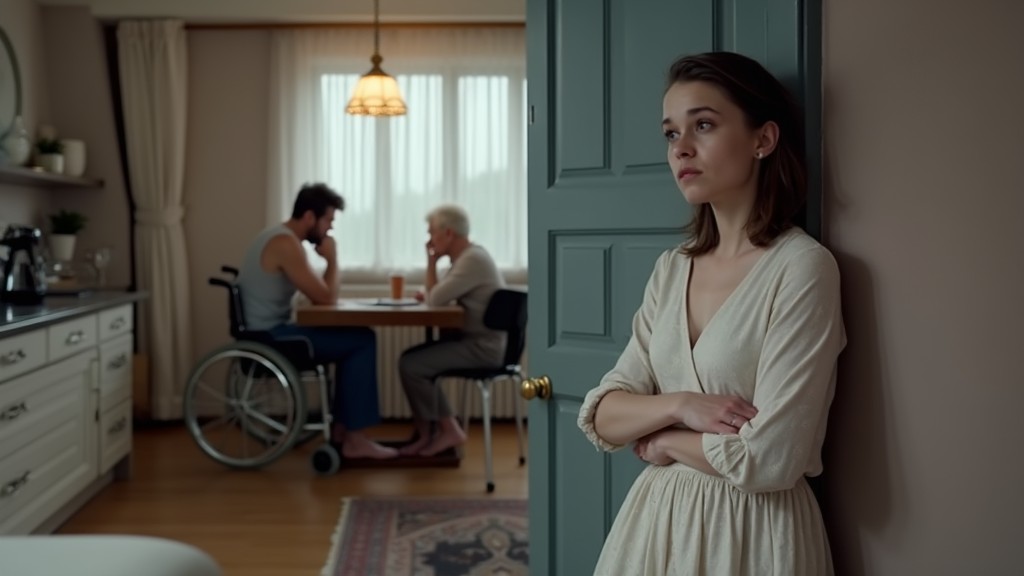
I came home in a wheelchair, hoping my family would be glad I was alive! Instead, their first question was about money… and what happened next changed our relationship forever
Human.
Finally, I opened Dad’s message.
«We’re meeting with the financial counselor tomorrow. Your suggestion.» A pause. «Thank you.»
The words were stiff, uneven, like he’d typed them with a trembling thumb. My dad wasn’t a man built for apologies. He was built for straight rows in the garden, for stubborn pride, for telling the world he didn’t need help even when he did. But this message—it was the closest thing to remorse I’d seen from him in years.
Mom’s message came next.
«I’m sorry for what I said at the table.» A long pause. «I didn’t know how to handle everything. I still don’t.» Then, «If you want some of your things back, we saved a few.»
I set the phone down. My throat felt tight, but not from pain. More like something inside me was finally unclenching.
Then came my brother’s message.
«I was a jerk. You didn’t deserve any of it.» A few dots appeared. «I didn’t know you were hurting too.»
Hurting too. It only took eight months of rehab, a wheelchair, a forged signature, and a blown-up family dinner for him to see that. But still, it mattered.
I didn’t reply right away. I needed time to sit with it, to let it settle. Forgiveness isn’t a switch you flip. It’s a door you open slowly, only when you’re ready.
That afternoon, I rolled outside to the small courtyard of the apartment complex. A few veterans were out there—men older than me, hair gray, hands rough, eyes soft with that mixture of pain and humor only combat vets carry.
One of them, a retired Army sergeant named Bill, waved me over. «You look like someone who’s been through a day,» he said.
«More like a decade,» I answered.
He chuckled. «Pull up a chair.»
I gestured to my wheels. «Already brought one.»
That earned me a laugh from the whole group. We sat there under the weak autumn sun, talking about nothing and everything—bad cafeteria food, stubborn doctors, the labyrinth of VA paperwork, memories from places none of us wanted to revisit but all of us needed to speak aloud. It wasn’t therapy, but it was healing.
Bill looked at me after a while and said, «You know, you got a spine on you. Chair or no chair.»
I smiled. «Working on it.»
Later that week, I met with my VA counselor again. We went over the next steps for my independence plan: job training, accessible transportation, therapy options, support groups. It felt like building a life from the foundation up. Slow. Steady. Real.
And then, a week later, my parents asked if they could meet me. In public. Neutral ground. A diner outside town—the kind with mismatched coffee mugs and vinyl booths that stick to your jeans.
I went. Not because I owed it to them, but because I owed it to myself.
They were already seated when I rolled in. Dad stood up awkwardly, as though he wasn’t sure whether to shake my hand or hug me. Mom looked smaller somehow, like the fear and shame had wrapped her tight.
We talked. Not perfectly, not smoothly, not with Hollywood music swelling in the background. Dad apologized again, haltingly, like a man unlearning bad habits. Mom said she’d been scared, overwhelmed, ashamed of needing her own daughter. My brother admitted jealousy and resentment he never knew how to talk about.
And me? I told them the truth.
«I can forgive you,» I said, «but I can’t go back to the way things were.»
They nodded, slowly, painfully, but they nodded.
We talked about boundaries. About their responsibility. About how I could help—advice, resources, information—but not financially. Not through signatures. Not at the cost of my health or future.
By the end of the meal, something softer lingered in the air. Not reconciliation, exactly, but the beginning of it. A seed. Something that could grow if we tended it carefully.
When the check came, Dad reached for it. Mom stopped him gently.
«Split it,» she said. «We’re starting new.»
I almost laughed. Not because it was funny, but because it felt like something shifting—an old gear finally catching a new tooth.
On the drive home, I passed the old elementary school, the grocery store where I once bagged apples as a teenager, the football field where I’d watched my brother play. Everything looked the same. And nothing did.
I wasn’t the girl who left. I wasn’t the soldier who came back. I was something in between. Someone rebuilding. Relearning. Reclaiming.
A few days later, I visited the Veterans Memorial downtown. The stone wall was cold under my hand. I traced the engraved names of friends I’d lost, people who never came home to fight the battles I was fighting now.
«I made it back,» I whispered. «And I’m still figuring out what that means.»
A breeze moved through the trees, rustling the flags overhead—a reminder that even in stillness, there is movement. Even in wounds, there is rebuilding. Even in fractured families, there can be a road forward. Not perfect. Not easy. But possible.
As I rolled away from the wall, I thought about the people who would hear my story. People my parents’ age, my grandparents’ age. People who lived through hard decades, who knew about pride and forgiveness, and the complicated knots families tie. And I hoped they’d hear this message:
You can forgive without going back. You can love without losing yourself. And sometimes, the bravest thing you can do is choose peace—not with others first, but with yourself.