I Hired A Cleaning Lady When No One Was Home. She Called Me: “There’s Someone In Your House…”
My entire body went cold. The cheerful noise of the garden café around me—the clinking of cups, the murmur of conversations—seemed to fade into a dull, distant hum. I was meeting my old friend, Clara, for the first time in a decade, but the smile was frozen on my face. The phone was pressed hard against my ear.

“Mrs. Abigail?” a trembling voice whispered. It was Lily, the college student I’d hired to clean the house. “Is… is anyone else supposed to be here?”
I tried to keep my tone even, for Clara’s sake. “No, of course not. I’m out with a friend. My husband, David, is at his office at the financial firm. He won’t be home until much later. Why are you asking me this, Lily?”
There was a beat of silence, broken only by her short, panicked breaths. Then her voice cracked. “There’s a woman. Up on the second floor. I was dusting the banister, and I saw her walk down the hallway. She had on this long, faded nightgown. Her hair was all tangled. She just… vanished into the last bedroom.”
An icy dread shot straight through my heart. I muttered a quick apology to Clara, whose face was now etched with concern, and stood up from the wrought-iron table. “Lily, listen to me,” I said, my own voice starting to shake. “Get out of the house right now. Don’t stop for anything. Go outside, lock the door, and wait for me. I’m on my way.”
I practically ran to my car, my fingers fumbling as I dialed 911. I drove through the streets of our quiet Connecticut town like a woman possessed, my knuckles white on the steering wheel. Every red light felt like a personal insult. I tried calling Lily back, but it just rang and rang, each tone amplifying the terrifying images flashing in my mind.
When I finally skidded onto our street, a police cruiser was already parked at the curb. Lily was huddled on the front porch steps, her arms wrapped tightly around herself. Her face was as pale as chalk.
I rushed over and pulled her into a hug. “Are you okay? What happened? Did you see anything else?”
She just shook her head, her lips pressed into a thin, terrified line. Two officers—a seasoned veteran with a calm demeanor and a younger, more earnest one—emerged from the house. They had combed through every room, every closet, even the crawl space. They found no one. There were no signs of a break-in. Every window and door was securely locked.
A wave of relief washed over me, but it was quickly followed by a nagging unease. This house was old, a Victorian that had been in David’s family for generations. Its ornate woodwork and shadowy corners had always felt a little… watchful.
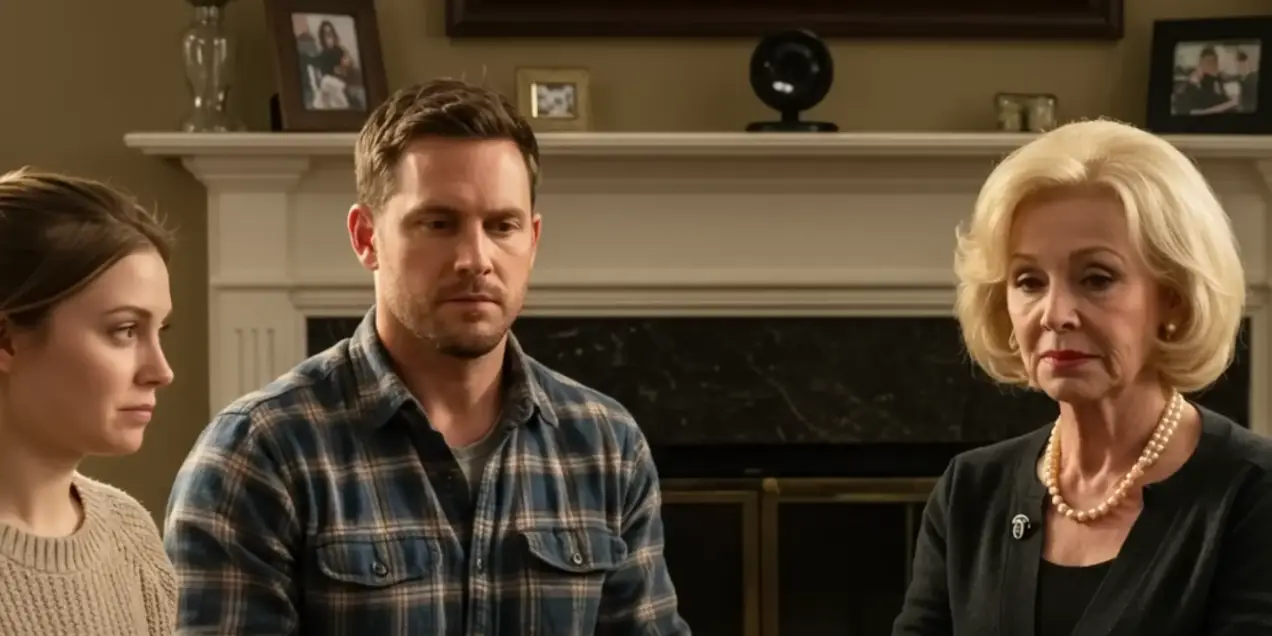
Just then, David’s sedan pulled into the gravel driveway. He stepped out, his expression a mix of surprise and confusion at the scene. I hurried over, grabbing his arm and spilling out the story in a rushed, anxious torrent. I expected him to share my alarm, but he simply listened, then gave a slight, dismissive smile. He walked over to Lily, placing a comforting hand on her shoulder.
“You’ve had a long day, kiddo,” he said, his voice soft and almost patronizing. “This old place plays tricks on you. The light through the stained-glass windows, the shadows from the big oak tree… it’s easy to see things that aren’t there.”
Lily looked down, embarrassed. I felt a pang of sympathy for her. She wasn’t a flighty girl; she was pragmatic and hardworking. But David’s calm, rational tone was so convincing that I started to doubt everything.
A few months later, I settled into retirement. The quiet days, however, brought sleepless nights. That’s when I first heard the noises from the attic—a soft, scuffling sound at first, then the unmistakable drag of something heavy across the floorboards. I brought it up with David over breakfast.
“It’s just squirrels, Abby,” he said, not looking up from his tablet. “Or maybe mice. I’ll pick up some traps.”
He did, and for a little while, the noises stopped. But then other things began to happen. A special loaf of cinnamon-raisin bread I’d bought—a treat David claimed to despise—had a large slice missing, torn away raggedly. When I asked him about it, he just shrugged. “I must have had a midnight craving.” A few days later, the rest of the loaf was gone.
Then, one evening after we’d been out all day, I went upstairs to find the bathroom floor sopping wet, as if someone had just stepped out of the shower. Drops of water still gleamed on the porcelain.
“David!” I called out, my voice trembling. “The bathroom floor is soaked!”
He came in, glanced around, and shrugged. “Must be a leak from that afternoon rain.”
I looked out the window. The pavement was bone dry. “It hasn’t rained, David.”
He sighed, a hint of annoyance in his voice. “Then it’s the old pipes. I’ll call a plumber.” He never did.
The pieces didn’t fit. The attic noises, the missing food, the mysterious water. They were like scattered puzzle pieces from a box I couldn’t find the lid for.
The breaking point came when I was tidying David’s study. As I lifted a stack of his financial reports, a hidden, stuck drawer in his old desk suddenly sprang open. Inside, beneath some faded stationery, was a small, leather-bound journal. It was worn and soft with age, completely unlike David’s preference for sleek, modern devices. My hands trembled as I opened it. The pages were filled with elegant, flowing handwriting—clearly a woman’s. They were outlines for stories, rich with detail and emotion, about lonely lighthouses and forgotten towns. They felt hauntingly familiar, echoing the themes of the bestselling novels that had made David’s name.
My blood ran cold. David never wrote by hand. He found it tedious. So whose journal was this?
That night, I was jolted awake by a faint creak from the hallway. The attic door was slightly ajar, a dark slit letting out a draft of cold, stale air. I woke David, but by the time we got there, the door was firmly latched shut. He looked at me with a mixture of exhaustion and pity. “Abby, you’re not sleeping well. You’re imagining things.”
I started watching him more closely. He began a new ritual, claiming he needed absolute quiet to work in his study late at night. One night, I woke to find his side of the bed empty and cold. I found him not in his study, but creeping down the main staircase, carrying an empty dinner plate.
“I got hungry,” he explained, his voice tight. “I needed a quiet place to think.”
The final clue came from his editor, a sharp-faced man named Mr. Peterson, who showed up at our door demanding a manuscript that was weeks overdue. “Stop covering for him, Mrs. Abigail,” he snapped. “Your neighbor, Mr. Jenkins, sees the attic light on every single night. If he’s working up there, he must have something to show for it.”
The attic light. The one place we never went.
A cold resolve settled over me. I dragged the old ladder from the garage and placed it under the attic hatch. The rusted latch gave way with a groan. The air that tumbled out was thick and smelled of dust and loneliness.
I climbed up, my phone’s flashlight cutting a frail beam through the darkness. And in the far corner, I found her. A space was arranged with a small cot, a table, and a battery-powered lamp. A woman, gaunt and pale, with long, silver hair, was sitting at the table, writing. She turned, and my legs nearly buckled.
It was Eleanor. My sister. The sister our family believed had run away with a married man thirty years ago.
The world tilted on its axis. The life I knew shattered into a million pieces. Eleanor, her voice a dry rasp from disuse, told me everything. Her boss at the publishing house had attacked her. She’d fought back, and he’d fallen, hitting his head. It was an accident. David had arrived, found her in a state of shock, and instead of calling the police, he’d hidden her. He’d buried the man’s body upstate and made Eleanor a ghost in our home. He’d used my grief, her fear, and his own cunning to lock her away. And all these years, he had been passing off her brilliant writing as his own.
The next morning, I took Eleanor to the police station. She confessed everything with a calm, clear voice I hadn’t heard in decades. They found the remains where she said they would be. An arrest warrant was issued for David.
I hired a lawyer for Eleanor, hoping her three decades of imprisonment would be seen as punishment enough. But a few days later, I received a call. Eleanor had passed away in her sleep at the holding facility. The officer said she’d left a letter for me.
My dearest Abigail, it began. When you read this, I will finally be free. Don’t be sad. I have written my final story. You will find the manuscript in a metal box under the floorboard near the attic window. If you can, please see that it is published under my name—Eleanor Rose.
I found the box. I read her story, her real story, through a veil of tears. I had it published. The world finally knew the truth about the brilliant writer they had never known, and the man who had built his fortune on her stolen life and freedom. David was convicted on multiple charges. The house is quieter now. I go up to the attic sometimes, not as a place of dread, but as a memorial. I open the window to let in the light and the sound of the world she loved but could never rejoin. In a way, she finally got her voice back. And I learned that some secrets fester in the dark, and the only way to heal is to finally, bravely, bring them into the light.
The silence in the house after everything was a different kind of quiet. It wasn’t the empty stillness I’d known before; it was a heavy, settled silence, thick with memory and the ghost of a truth I could never un-know. I wandered through the rooms, my footsteps echoing on the hardwood floors, each creak a reminder of the decades of footsteps that had been hidden from me.
I kept my promise to Eleanor. The manuscript in the metal box wasn’t just a story; it was her soul poured onto paper. It was titled Whispers from the Attic. I took it to a small, independent publisher in Vermont, far from the glossy, scandal-hungry world that had celebrated David. The editor, a kind-eyed woman named Sarah, read it in one sitting and called me, her voice choked with emotion. «We will publish this exactly as she wrote it,» she said. «It’s the least she deserves.»
When the advance copies arrived, I held one in my hands, the weight of it feeling profound. Eleanor Rose. Her name was on the cover, in elegant, understated type. It was real. I cried that day, not just from grief, but from a fierce, proud joy. She had done it. She was an author.