My Husband Called Me Barren! Then I Left an Envelope at a Luxury Dinner That Ended His Lies…
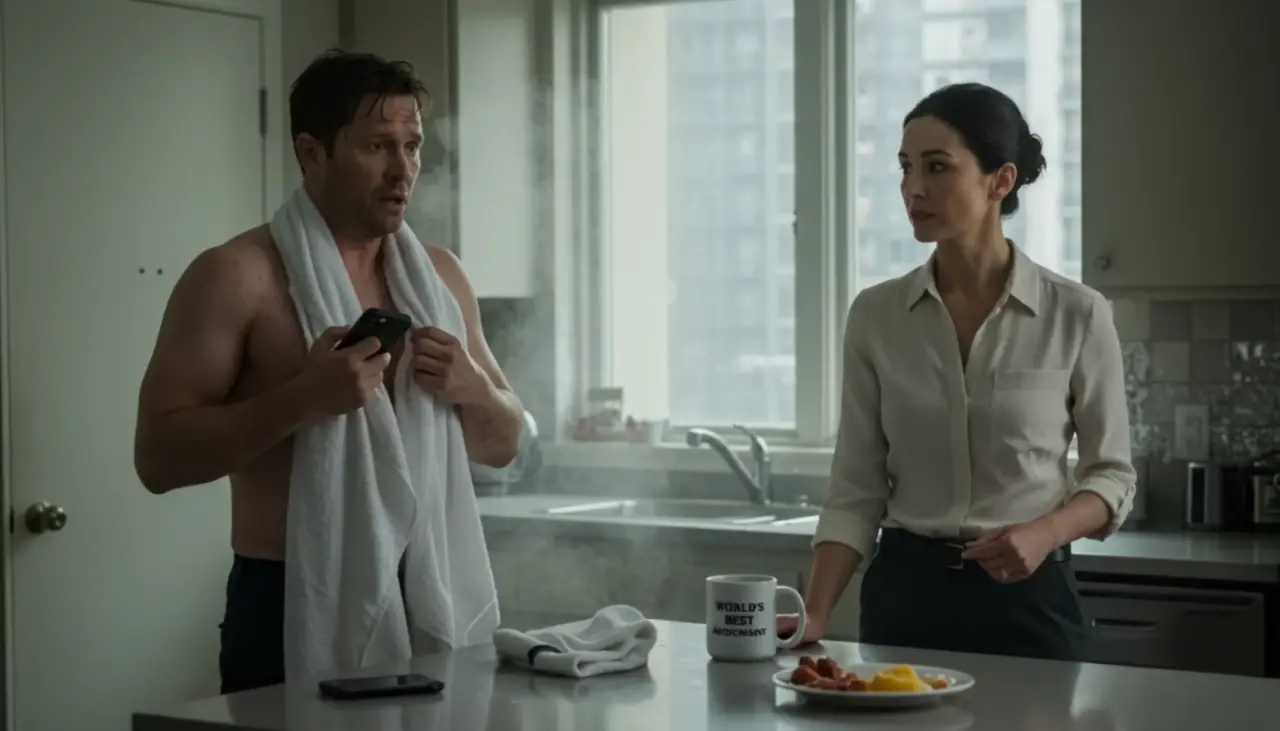
This mug had survived my grandmother’s marriage of sixty-two years, had traveled from her kitchen in Ohio to mine in Chicago, had held thousands of cups of coffee through joy and sorrow and ordinary mornings that now seemed precious in their simplicity.
«Leave it,» Jeffrey said, already standing, stepping backward to avoid the spreading coffee. «I’ll get paper towels.»
But I didn’t leave it. I collected each piece carefully, cradling them in my palm like injured birds. The forget-me-nots were still visible on the larger fragments, their blue paint unchanged despite the violence of the break. As my fingers found each shard, I realized I wasn’t gathering broken china. I was collecting evidence of something larger shattering, something that couldn’t be glued back together with apologies or explanations.
Jeffrey returned with an entire roll of paper towels, dropping them on the spill from a safe distance, watching me kneel among the ruins with an expression I couldn’t read. Impatience, maybe. Or disgust that I was making such a production of a broken cup when he’d just diagnosed me as defective.
«It’s just a mug,» he said.
«It was my grandmother’s.»
«We’ll get you another one.»
The casual dismissal of something irreplaceable. That told me everything. Jeffrey could fabricate medical reports, could practice speeches in mirrors, could orchestrate this entire morning like a theatrical production, but he couldn’t understand that some breaks couldn’t be fixed with replacement parts. Some things, once shattered, stayed that way.
I stood, still holding the ceramic pieces, coffee seeping through the paper towels toward the folder he’d left on the table. The brown liquid reached the edge of his fake medical reports, staining them with the truth of this moment: messy, spreading, impossible to contain.
«I need some air,» I said, surprising myself with how steady my voice sounded.
«We’re not done talking.»
«Yes,» I said, looking directly at him for the first time since he’d started his performance. «We are.»
I walked to our bedroom, still carrying the broken pieces of my grandmother’s mug, and carefully placed them in a small box from my jewelry drawer. Behind them, in the filing cabinet Jeffrey had never bothered to explore, my real medical records waited. Perfect reproductive health. Optimal hormone levels. Everything functioning exactly as it should. But I didn’t reach for them. Not yet. Because something in Jeffrey’s relief, in his practiced speech and fabricated evidence, told me this was bigger than just wanting to leave a marriage. This was about something else, something he was hiding behind medical folders and rehearsed sympathy.
I stood in our bedroom for ten minutes, the box containing my grandmother’s broken mug sitting on the dresser, before I heard Jeffrey’s car pull out of the garage. He was heading to his «emergency client meeting»—the one that materialized the moment I’d walked away from his performance. Through the window, I watched his BMW disappear around the corner, then waited another five minutes to be sure he wouldn’t circle back for something forgotten.
The door to his office stood open. Not just unlocked. Completely open, like he’d been in such a rush to escape the scene of his cruelty that he’d forgotten his precious security altogether. The digital keypad blinked green, the lock disengaged, his sanctuary vulnerable for the first time in months.
I pushed the door wider and stepped inside. The room smelled like his cologne, the expensive one I’d bought him last Christmas, mixed with something else. Coffee, maybe, and the faint sweetness of a perfume that definitely wasn’t mine. His desk was messier than he’d ever tolerate if he knew I’d see it. Papers were scattered across the surface, file folders stacked haphazardly, his usually organized space showing cracks in his perfect facade.
I started with the filing cabinet, my fingers walking through labeled tabs until I found one marked, «Taxes 2023.» But taxes weren’t what Jeffrey was hiding. Beneath the W-2s and receipts for business expenses, I found credit card statements for an account I didn’t know existed. The charges told a story that made my stomach twist. Victoria’s Secret, $127.43, Feb. 3. Another charge two weeks later, $89.99. Sizes listed on the detailed receipt: 32B, size small. I wore a 36C, size medium.
There were restaurant charges too. Giovanni’s, the Italian place he told me gave him food poisoning last year, swearing he’d never go back. Three charges in the past two months, always for exactly two dinners, always with wine pairings. Chez Laurent, where he’d claimed the portions were «pretentiously small» when I’d suggested it for our anniversary. Four visits since December.
My hands moved mechanically, taking photos of each statement with my phone, the camera click sounding too loud in the quiet office. A jewelry store receipt from January made me pause: $3,400 for pearl earrings. I’d never owned pearl earrings, had never even mentioned wanting them.
Jeffrey’s laptop sat open on his desk, the screen dark but not locked. One touch of the trackpad brought it to life. His email was already open, like he’d been checking it right before creating his morning theatrical production. The inbox showed mostly work correspondence, but a purple flag caught my eye—his personal filing system for what he marked as «important.»
The flagged emails were all from Angela Morrison. I knew Angela. She worked in accounting at Brennan & Associates, had started about six months ago. Pretty, blonde, maybe 28. She’d been at the holiday party where Jeffrey had introduced me as «just Amy.» And now I understood the sympathetic look she’d given me hadn’t been sympathy at all. It had been pity mixed with guilt.
The emails started professionally enough in November. «Thanks for your help with the Richardson portfolio.» «The client loved your presentation.» Normal workplace correspondence that no one would question. But by December, the tone had shifted. «Can’t stop thinking about lunch yesterday.» «Your cologne is still on my scarf.» «Missing your touch.»
January brought declarations. «I’ve never felt this way before.» «You make me believe in forever.» «Can’t wait until we don’t have to hide.»
But it was the February emails that stopped my breathing. An attached photo loaded slowly: an ultrasound image, grainy black and white, a tiny blob circled in red. The subject line: «Our little miracle, 12 weeks.»
Her message below: «I know the timing isn’t perfect, but this baby is our new beginning. After you leave Amy, we can finally be the family we’re meant to be. I love you both so much already.»
Twelve weeks. I did the math quickly. Conception in November, right when the emails had started. While Jeffrey had been avoiding my touch like I was contagious, he’d been creating a life with someone else. While he’d been calling me barren, broken, unfixable, Angela Morrison had been carrying his child.
I photographed everything. Every email, every declaration of love, every mention of their future plans. My phone storage filled with evidence of my husband’s double life, each image another nail in the coffin of his lies.
But I needed physical copies, needed them organized and undeniable. The library was my next stop. I told the librarian I was working on a legal project, which wasn’t entirely untrue, and she set me up at a computer in a corner. One by one, I uploaded the photos from my phone, adjusted them for clarity, and printed them on the library’s high-quality printer. The machine hummed and clicked, producing page after page of betrayal in full color.
I bought a binder from the office supply store next door—black, professional, the kind lawyers use for case files. Back at the library, I organized everything chronologically, using divider tabs labeled by month: November’s professional emails, December’s escalation, January’s declarations, February’s pregnancy announcement. Each piece was slotted into protective sheets, building a timeline of deceit that no one could dispute.
My hands had stopped shaking completely. Instead, they moved with surgical precision, creating a weapon made of truth and time stamps. When the binder was complete, I couldn’t take it home. Jeffrey might find it, might destroy it before I was ready. So I drove to my sister Carol’s apartment in Lincoln Park, used the spare key she’d given me years ago, and hid it behind her winter coats in the hall closet.
«Insurance,» I whispered to the empty apartment, though I knew it was more than that. It was proof. It was power. It was the beginning of something I couldn’t quite name yet.
The next morning, I called Dr. Young’s office. «I need copies of my test results,» I told the receptionist. «Official ones with letterhead. It’s for insurance purposes.»
Dr. Young saw me that afternoon, running the same tests she’d done weeks earlier just to make sure nothing had changed: blood draws, ultrasounds, hormone panels. The full diagnostic panel that would prove beyond any doubt what Jeffrey’s fake medical reports tried to deny.
«These numbers are exceptional,» Dr. Young said, reviewing the results on her computer. «You’re in the 95th percentile for fertility health in your age group. Actually, in any age group. I rarely see numbers this ideal.»
«Could you put that in writing?» I asked. «The insurance company needs detailed documentation.»
She printed multiple copies, each one stamped with her official seal, signed with her authoritative signature—medical proof that I wasn’t broken, wasn’t barren, wasn’t any of the things Jeffrey had tried to label me.
«Are you sure everything is okay?» Dr. Young asked as she handed me the folder. «You seem… different from your last visit.»
«Everything’s becoming very clear,» I told her, and for the first time in months, it was the complete truth.
I drove home from Dr. Young’s office with the folder of fertility results on the passenger seat, my mind already shifting into performance mode. If Jeffrey wanted a broken wife, I’d give him exactly that: a devastated woman grappling with her «barrenness» while he built his new life with Angela Morrison.
The first stop was the bookstore near our apartment. I gathered armfuls of adoption brochures from the family planning section, making sure to choose the ones with the most heart-wrenching photos: children waiting for homes, statistics about older couple adoptions, testimonials from parents who’d found alternative paths to parenthood.