At My Wedding Reception, My Mother In Law Slipped Something In My Champagne – So I Switched Glasses…
The pregnancy was complicated by my anxiety. I was terrified of something going wrong, convinced that happiness this big couldn’t last. Dr. Reeves helped me work through it, but even she couldn’t completely erase the fear.
«Given what you’ve been through, it’s natural to be hypervigilant,» she said. «You learned that people can hurt you when you least expect it. But Lori, you can’t let Caroline’s actions five years ago steal your joy now. That would mean she still has power over you.»
She was right. I refused to let Caroline take this from me.
The baby, a girl, was born on a snowy December morning. We named her Grace because that’s what she was: grace after the storm. Dylan cried when he held her for the first time. «She’s perfect, Lori. She’s absolutely perfect.»
She was. Ten fingers, ten toes, a shock of dark hair like her father’s, and eyes that looked up at us with complete trust. My mother was in the delivery room crying happy tears. Emma was in the waiting room with my father, probably posting a thousand photos on social media. Andrew flew in to meet his niece, his face lighting up when he held her.
«You guys are going to be amazing parents,» he said, his voice thick with emotion.
I looked at Dylan holding our daughter, his face full of wonder, and I believed it. We would be amazing parents. We would give Grace everything Caroline had failed to give her sons: unconditional love, freedom to be herself, support without control. We would break the cycle completely.
When Grace was three months old, Dylan got a letter from his mother. He stared at it for a long time before opening it. I gave him space, taking Grace into the nursery while he read it in the living room. When I came back, he was crying silently, the letter in his hands.
«What did she say?» I asked gently.
«She congratulated us on the baby. Andrew must have told her.» He wiped his eyes. «She said she’s sorry. That she thinks about what she did every day. That she knows she destroyed everything and she doesn’t expect forgiveness, but she wants us to be happy.»
«Do you believe her?»
«I don’t know. Maybe.» He looked at Grace sleeping in my arms. «I don’t want her in our lives, though. I don’t want her near Grace. I don’t trust her.»
«Okay.»
«Is that terrible? To keep a grandmother away from her grandchild?»
«No,» I said firmly. «It’s protecting your daughter. Caroline made her choices. These are the consequences.»
He nodded slowly, then folded the letter and put it away. He never responded to it.
Life continued. Grace grew from an infant to a toddler, a whirlwind of energy and laughter. Dylan got a promotion at work. I was made department head at my school. We took family vacations and hosted holidays and built the kind of life I dreamed about on my wedding day, before everything went wrong.
Sometimes people recognized us. «Weren’t you that couple from the viral wedding video?» they’d ask. Early on, it bothered me. Now I just smiled and said, «That was a long time ago.» Because it was.
Five years, then six, then seven. The past became more distant, its power over us fading. We had another baby, a boy we named James. Andrew got married to a wonderful woman named Sophie who worked at the same youth center he did. Robert reached out occasionally, awkward phone calls where he asked about the grandchildren he’d never met. Dylan was polite but distant.
«Some bridges are burned too badly to rebuild,» he explained to me. «Dad chose to abandon us when things got hard. I don’t owe him a relationship now.» I supported whatever he decided. This was his family, his trauma to navigate.
Caroline finished her probation. The ten-year no-contact order was still in effect, so she couldn’t reach out directly, but Andrew told us she’d moved again, was working in a library, and lived alone.
«She asked if she could see pictures of the kids,» Andrew said hesitantly during one visit. «I told her I’d ask you.»
Dylan and I looked at each other. «No,» we said together.
Andrew nodded. «I figured. I just promised I’d ask.»
«Does she understand why?» I asked.
«I think so. She knows what she did. She knows some things can’t be fixed.»
Maybe that was her real punishment. Not the prison time or the social exile or the divorce, but knowing that her sons had families she’d never be part of, grandchildren she’d never hold, a life continuing without her. She’d gambled everything on controlling Dylan’s life, and she’d lost it all.
Eight years after the wedding, I got a call from a producer at a documentary series about crime and justice. They wanted to feature our story.
«Absolutely not,» was my immediate response.
«Please, just hear me out,» the producer said. «We’re doing a series on attempted poisonings and how they’re prosecuted. Your case is compelling because the security footage was so clear and because of the family dynamics involved. We’d handle it sensitively.»
«My answer is still no. I don’t want to relive that.»
Dylan agreed. «We’ve moved on. We don’t need to drag it all up again for entertainment.»
But Andrew had a different perspective when we told him about it. «Maybe you should do it,» he said.
«Why would we do that?» Dylan asked.
«Because there are probably other people out there dealing with toxic family members. People who think they’re crazy for being afraid of their own mother-in-law or father or whoever. Your story shows that sometimes your instincts are right. Sometimes the people who are supposed to love you really are dangerous. Maybe it would help someone.»
I’d never thought about it that way. Dylan and I talked about it for weeks. We watched episodes of the documentary series to see how they handled sensitive topics. We talked to Dr. Reeves about the potential psychological impact of revisiting the trauma. Finally, we agreed, but only if we had complete control over our interview, could review the footage before it aired, and could include resources for people dealing with family trauma.
The filming was harder than I expected, sitting in front of cameras, telling the story again, watching the old security footage and viral videos. I cried more than once. So did Dylan. But there was also something cathartic about it, about owning our story completely, about saying, «This happened to us, it was terrible, but we survived.»
The episode aired a year later. We watched it together at home, Grace and James asleep upstairs, holding hands on the couch. They’d done a good job. They presented the facts clearly, included the security footage and trial testimony, but also focused on the aftermath—on healing and resilience. At the end, Dylan and I spoke directly to the camera.
«If you’re in a situation where someone is trying to control or manipulate you—even if it’s family, especially if it’s family—trust your instincts,» Dylan said. «Lori’s instincts saved her that night. They saved us.»
«And don’t be afraid to protect yourself,» I added. «Even if it means upsetting people or breaking family loyalty. Your safety matters more than keeping the peace.»
The episode got a strong response. My inbox filled with messages from people sharing their own stories of toxic family members, of standing up to abuse, of choosing their own well-being over family expectations. One message stuck with me. It was from a young woman named Beth who wrote: «I saw your episode and cried. My future mother-in-law has been making my life hell, and my fiancé keeps telling me I’m overreacting. After watching what happened to you, I realized I’m not crazy. I’m not overreacting. She really is trying to sabotage our relationship. I showed him the episode, and for the first time, he actually listened. We’re in counseling now, setting boundaries. Thank you for sharing your story. You might have saved my relationship. Maybe even my life.»
I showed the message to Dylan. «Maybe Andrew was right,» he said quietly. «Maybe some good can come from what happened.»
«Doesn’t make it hurt less,» I said.
«No, but it makes it mean something.»
On our tenth anniversary, we finally took that trip to Italy. We left the kids with my parents and flew to Rome, then Florence, then the Amalfi Coast. We ate amazing food, drank wine, walked through ancient streets, and remembered what it felt like to just be us: Dylan and Lori. Not parents, not trauma survivors, not the couple from that viral video. Just us.
On our last night, we sat on a terrace overlooking the Mediterranean, the sunset painting everything gold and pink.
«I’ve been thinking about that day a lot,» Dylan said. «Our wedding day.»
«Yeah?»
«About how it was supposed to be perfect, the happiest day of our lives. And how it turned into this nightmare instead.» He took my hand. «But you know what? I don’t regret it.»
I looked at him in surprise. «You don’t regret your mother trying to poison me?»
«No, of course I regret that. But I don’t regret what came after. Because it showed me who you really are. How strong you are. How brave. You saw danger and you didn’t freeze or panic. You protected yourself. And then you stood up in court and told the truth, even when my whole family was against you. Even when I didn’t believe you at first.»
«Dylan…»
«Let me finish. That day was supposed to be about promising to love each other forever, and we did that. But the days after, those showed me that you were someone I could actually build a life with. Someone who wouldn’t crumble when things got hard. Someone who’d fight for us.»
Tears blurred my vision. «I was so scared I’d lost you. When you went to stay with Thomas, when you doubted me.»
«I know. I’m sorry for that. I should have believed you immediately. But Lori, even in my doubt, I never stopped loving you. And every day since then, I’ve loved you more. You gave me a real family. Grace and James and Andrew and even your parents. They’re more family to me than my own blood ever was.»
«They love you too.»
«I know.» He pulled a small box from his pocket. «I got you something.»
«Dylan, we agreed no expensive gifts.»
«It’s not expensive. Just meaningful.»
I opened the box. Inside was a delicate silver necklace with a small pendant in the shape of a champagne flute. I looked up at him in surprise.
«I know it seems strange,» he said quickly. «But I wanted you to have something that represents that night. Not the trauma, but the victory. You switched the glasses. You saved yourself. You won. This is a reminder that you’re a survivor. That you’re stronger than anyone who tries to hurt you.»
I put on the necklace with shaking hands. The pendant rested right over my heart. «Thank you,» I whispered. «Thank you for seeing her for who she really was. For trusting your instincts. For saving us both.»
We kissed as the sun set over the Mediterranean. Ten years of marriage behind us. A lifetime ahead.
Twelve years after the wedding, I was at the grocery store with Grace when I saw her. Caroline. She was in the produce section, older and grayer, wearing a simple cardigan and jeans, nothing like the designer clothes she’d once favored. She was examining apples, her cart containing the basics: bread, milk, cereal. The cart of someone living alone on a budget.
She looked up and saw me. For a moment, we just stared at each other.
Grace tugged on my hand. «Mommy, can we get strawberries?»
«Sure, sweetheart.» I started to turn away, to pretend I hadn’t seen her.
«Lori.» Caroline’s voice was soft, hesitant.
I stopped. Grace looked up at the stranger curiously.
«I’m sorry,» Caroline said. «I know I’m not supposed to approach you. I know the no-contact order just ended last month, but you probably still don’t want to see me. I just… I needed to say I’m sorry. For everything.» She looked at Grace. «Is this your daughter?»
I instinctively pulled Grace closer. «Yes.»
«She’s beautiful. She looks like Dylan.» Caroline’s eyes were wet. «I saw the documentary. You both spoke so well. And I heard about the other children… two more?»
«Yes.»
«That’s wonderful. Dylan always wanted a big family.» She wiped at her eyes. «I’m not asking for anything. I know I don’t deserve to be part of your lives. I know what I destroyed. I just wanted you to know that I’m truly sorry. What I did was unforgivable. I let my need for control destroy everything that mattered, and I live with that every day.»
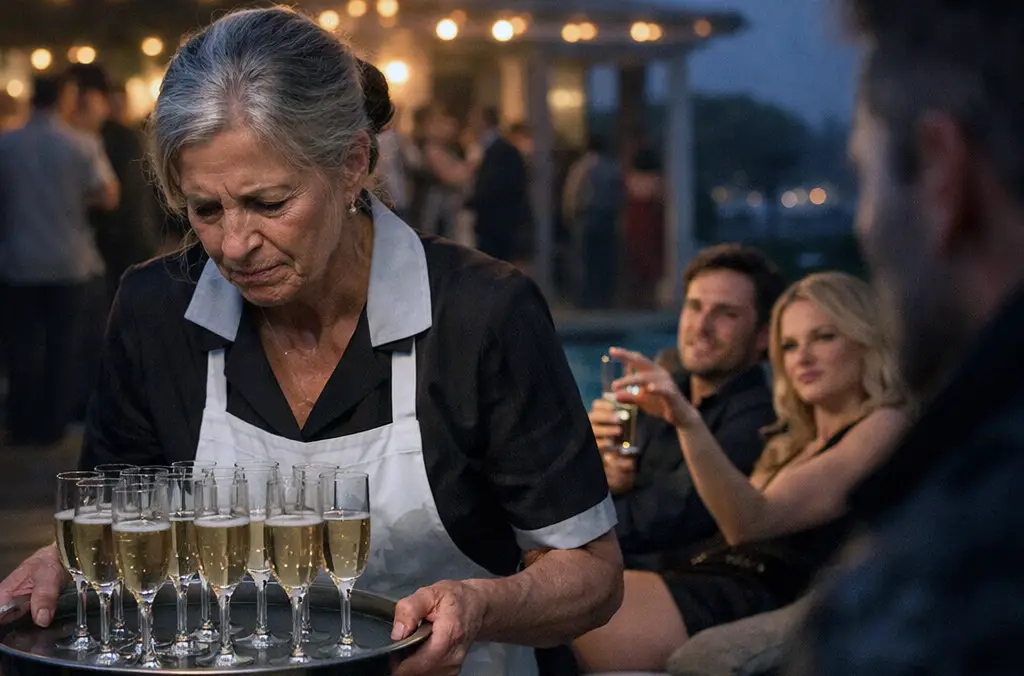
She looked genuinely broken, not the composed, perfect society woman who’d slipped poison into my champagne, but a lonely old woman who’d lost everything. I should have felt vindicated. This was karma playing out exactly as it should. But mostly, I just felt tired.
«I appreciate the apology,» I said carefully. «I hope you’ve found peace.»
«I’m working on it. Therapy helps. Working at the library helps. I volunteer at a women’s shelter now, helping people escape abusive situations.» She laughed bitterly. «The irony isn’t lost on me. I was the abuser in my own family, and now I help others escape theirs.»
«That’s good. That you’re helping people.»
«It doesn’t make up for what I did.»
«No. It doesn’t.»
Grace tugged my hand again. «Mommy, I want to go.»
«Okay, baby.» I looked at Caroline one last time. «I forgive you.» The words surprised me as much as they surprised her.
«You what?»
«I forgive you. Not for you, but for me. I’m tired of carrying the anger. It’s been twelve years. I have a good life, a family I love. You can’t hurt me anymore. So I forgive you, and I’m letting it go.»
Caroline’s face crumpled. «Thank you. God, Lori, thank you.»
«But I don’t want you in my life. Or my children’s lives. Dylan gets to make his own choice about whether he wants contact with you, but my boundary is firm. I forgive you, but I don’t trust you. I don’t want a relationship with you.»
She nodded, tears streaming down her face. «I understand. That’s more than I deserve.»
I took Grace’s hand and walked away. As we left the produce section, Grace looked up at me. «Who was that lady, Mommy?»
«Someone from a long time ago, sweetheart. No one important.»
And in that moment, it was true. Caroline had once loomed so large in my life, this terrifying figure who tried to destroy me. But now she was just a sad old woman in a grocery store, living with the consequences of her choices. I’d won. Not because she’d lost everything, though she had, but because I’d built something beautiful from the ashes of that terrible day: a marriage that had been tested and survived, children who were loved unconditionally, a life full of purpose and meaning and joy.
That night, I told Dylan about the encounter.
«How do you feel?» he asked.
«Free,» I said honestly. «I told her I forgave her.»
«Wow. That’s big. Are you upset?»
«No. It’s your choice to make.» He was quiet for a moment. «Do you think I should reach out to her?»
«That’s your choice to make.»
He thought about it for a long time. In the end, he decided to write her one letter, not to rebuild a relationship but to find closure. He told her he’d moved forward with his life, that he had a family he loved, and that he wished her well but didn’t want contact. She wrote back, thanking him and promising to respect his wishes. And that was that. The final chapter closed.
Life went on. Grace started middle school. James developed a passion for soccer. Dylan and I celebrated fifteen years of marriage, then twenty. We grew older, grayer, softer around the edges.
Sometimes people still recognized us from that old viral video or the documentary. «Weren’t you the champagne-switching couple?» they’d ask.
«Yes,» we’d say. «That was us.»
«That’s so crazy. Whatever happened to the mother-in-law?»
«She served her time,» I’d say simply. «She’s living her life, we’re living ours.»
Because that was the truth. Caroline’s story and ours had diverged that night at the wedding reception when I switched the glasses. She’d gone down a path of consequences and loss. We’d gone down a path of healing and building. Both paths were real. Both were deserved. But only one was marked by redemption and hope.