On the Third Night After Her Son Vanished, a Wild Bobcat Knocked on Her Window — and Led Her to a Cabin Where a Stranger’s Old Photo Had Her Face
By the third night, Rachel Porter had learned that hope made ordinary sounds cruel. A car slowing down on the county road could be a deputy coming back with news. A branch scraping the siding could be Eli trying to climb in through the mudroom window. The old refrigerator kicking on could, for one stunned second, sound like a child’s feet running across the kitchen.
Then the house would settle again, and Rachel would remember that her seven-year-old son was still somewhere beyond the tree line.
She was sitting on the hallway floor with Eli’s rain boots in her lap when the tapping started.
Not a scrape. Not the random slap of a moth against glass.
Three clear taps came from the living room window.
Rachel lifted her head. Across the room, Luke stopped pacing with his phone in one hand and a cold mug of coffee in the other. He had not slept long enough to dream in three days, and his face had taken on a gray, paper-thin look that made him seem older every time Rachel looked at him.
“Did you hear that?” she whispered.
Luke set the mug down carefully, as if any sudden sound might scare off whatever answer had come to them. They moved together into the living room, past the couch where volunteers had left folded maps and empty paper cups, past the fireplace mantel crowded with Eli’s school pictures. Rachel reached the window first and pulled the curtain aside.
At first she saw only the porch, washed in the pale yellow light above the steps. Then something shifted on the railing.
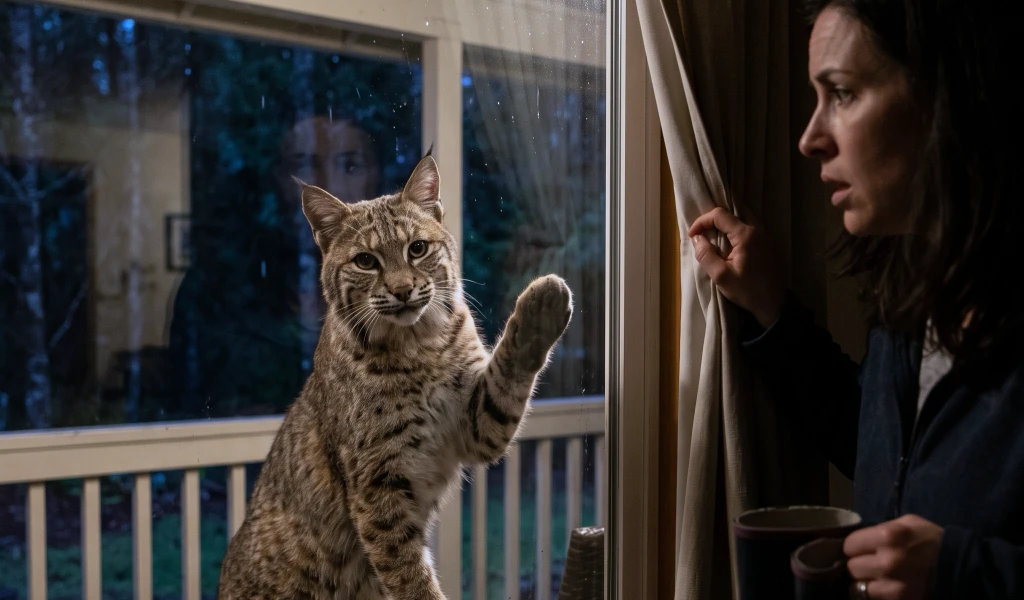
A bobcat sat less than four feet from the glass.
Rachel’s hand tightened around the curtain. She had lived in Cedar Hollow, Oregon, long enough to respect the woods behind their house. Deer came through at dawn. Coyotes sang from the ridge. Once, during a snowy winter, a black bear had dragged their trash can thirty yards into the trees.
But bobcats were ghosts. You caught a tawny blur in the headlights or saw tracks in creek mud and told yourself you had been lucky.
This one did not run.
It sat with its paws tucked neatly beneath it, ears sharp and black-tufted, its spotted coat catching the porch light in broken gold. Its eyes were fixed not on the room, but on Rachel.
“Back up,” Luke murmured. “It could be sick.”
Rachel did not move. The animal raised one paw and touched the glass.
Tap. Tap. Tap.
Luke’s breath caught behind her. For several seconds, none of them moved. Then the bobcat stepped down from the railing, crossed the porch, and paused at the top of the stairs. It looked back once, not like an animal startled by humans, but like a creature checking whether they understood.
Then it slipped off the porch and vanished into the dark edge of the timber.
Rachel stood with the curtain in her fist until Luke gently loosened her fingers.
“Rachel,” he said. “Hey. Look at me.”
She turned, but she was not really looking at him. She was looking past him, into the last seventy-two hours she could not stop reliving.
Eli had been in the backyard on Tuesday afternoon, wearing his red knit cap even though it was too warm for it, because his grandmother had made it and he claimed it helped him “think better.” Rachel had gone inside to answer a work call she should have ignored. Ten minutes, maybe twelve. Long enough for a client to complain about a missing invoice. Long enough for a little boy chasing a blue butterfly to push open the garden gate.
When Rachel came back out, Eli’s soccer ball was against the fence and the gate was swinging.
His footprints had lasted for twenty yards beyond the yard before the forest floor swallowed them.
By sunset, half the town was searching. By midnight, deputies had floodlights set up at the end of the road. Search dogs followed his scent toward Silver Creek and lost it near a rocky crossing where spring runoff spread over everything. Helicopters came the next morning. Volunteers drove in from two counties over. The sheriff’s office set up a table in the Porter driveway, and strangers with kind faces brought casseroles nobody could eat.
That afternoon, Sheriff Cole Bryant had taken Luke aside and said the words Rachel had been pretending not to hear.
They were scaling back the air search by morning.
Not stopping, he had insisted. Never stopping. But the forest was too wide, the weather was shifting, and people were exhausted.
Rachel had nodded like a reasonable person while something inside her folded itself around one thought: Eli was afraid of thunder. There was rain coming.
Now a bobcat had come to their window and knocked.
Luke locked the front door, though both of them knew how useless that was against what truly frightened them. “It was strange,” he said, choosing each word with care. “But it was still a wild animal.”
Rachel looked down at the boots in her hands. Dried mud clung to the rubber soles. Eli always put them on the wrong feet first and then laughed before switching them.
“What if it came from where he is?”
Luke closed his eyes. “Don’t do that to yourself.”
“I’m not doing anything.” Her voice came out low and rough. “It looked back.”
“Animals look back.”
“Not like that.”
He had no answer for her. By then they had run out of answers for almost everything.
The bobcat returned the next morning while two deputies were loading equipment into their truck. Rachel saw it from the kitchen window, moving along the porch rail with a confidence that made the deputies stop mid-conversation. She grabbed her phone and recorded as the animal tapped the glass three times, waited until she stepped closer, and then turned toward the woods.
One deputy laughed nervously. The other told her not to approach it.
Sheriff Bryant watched the video fifteen minutes later in the driveway. He was a broad, tired man with rain-darkened shoulders and the careful voice of someone who had delivered too much bad news in small towns.
“I understand why this feels meaningful,” he said.
Rachel stared at him. “That’s not an answer.”
“No, ma’am. It’s caution.” He handed the phone back. “We’ve had animals behave strangely around search scenes before. Scavengers, predators, curious wildlife. I don’t want you getting hurt because grief is making a pattern out of something random.”
Luke put an arm around her, but Rachel stepped out of it. “Then send someone that way.”
“We searched the lower ridge twice.”
“Not where it went.”
The sheriff glanced toward the trees. “Show us the video again, and I’ll have a team look at the section behind your property.”
They did. They found nothing.
By late afternoon, the volunteers had thinned. Rain hung over the mountains, making the light go flat and green. Rachel was at the sink, rinsing a glass she could not remember using, when she heard it again.
Tap. Tap. Tap.
Luke came from the hallway already shaking his head, as if he had known before he saw it.
The bobcat stood at the living room window, damp from the mist, its tail flicking once. This time it did not settle onto the railing. It paced, turned, tapped again, and looked straight at Rachel.
She was already moving toward the mudroom.
“Rachel,” Luke said.
She pulled Eli’s old daypack from the hook and stuffed in two water bottles, a flashlight, a first-aid kit, and the emergency whistle they had bought for camping trips. Her hands shook, but not from indecision.
“I’m going.”
“No. We call Bryant.”
“And wait another hour for him to tell me I’m hysterical?”
“He won’t say that.”
“He already did, politely.”
Luke blocked the door, not with anger, but with fear. “If that thing leads you into a ravine, Eli still doesn’t have you.”
Rachel looked at him then, really looked. He was barely holding himself together. His bottom lip had a split from where he kept biting it. There was dirt under his nails from clawing through creek banks and fallen brush, and she knew he had gone into the garage twice that day so she would not see him cry.
“I can’t sit in this house and listen for a child who isn’t here,” she said. “Not when something is trying to show us a direction.”
Luke swallowed. Then he turned, took his coat from the hook, and grabbed the roll of neon trail tape from the shelf.
“If it bolts, we stop,” he said. “If it gets aggressive, we stop. If one of us loses footing, we stop.”
Rachel nodded because those were the words he needed her to nod to.
Outside, the bobcat waited at the bottom of the porch steps. When they stepped down, it moved away, not fast enough to disappear, not slow enough to seem tame. It kept twenty or thirty feet ahead, padding between sword ferns and low salal, pausing whenever the Porters stumbled over roots or had to duck beneath fallen branches.
The land behind their house had always looked familiar from a distance. Rachel knew the deer trail near the fence, the bend where Eli liked to collect acorns, the old cedar stump he called his castle. But within fifteen minutes the bobcat had taken them beyond anything she recognized. The forest thickened into a wet, breathing maze of fir trunks and moss-covered stones, and the house disappeared behind them as if it had never existed.
Luke marked branches with the tape. Every few minutes he checked his phone, though there was no signal. Rachel kept her eyes on the bobcat’s pale hind legs moving through the undergrowth.
Once, near a creek she had never seen before, Luke caught her elbow and whispered, “Listen.”
They both stood still.
No child called out. No twig snapped in answer. Only water over rock, wind in the canopy, and somewhere high above, the thin cry of a hawk.
The bobcat waited on the far bank.
They crossed where the creek narrowed, Rachel soaking one boot to the ankle. The animal led them uphill after that, through timber so old the lower branches had died and left the trunks rising like pillars. Rachel’s lungs burned. Luke’s breath came hard behind her. Neither of them suggested turning back.
After nearly an hour, the trees opened without warning.
A cabin stood in the clearing.
What remained of it leaned under years of rain and neglect, its porch sagging, roof caved in over one corner, windows black with dirt. Vines had climbed the north wall and threaded themselves through the broken boards. The place looked abandoned enough to belong to no one, yet Rachel had the sudden, sharp sense that it had been waiting.
The bobcat sat at the threshold.
Luke lifted a hand. “Rachel. Let me go first.”
She heard him, but her body had already chosen. She crossed the clearing, stepped onto the porch, and pushed the door with two fingers. It opened on a long wooden groan.
Dust and leaf mold filled the air. Her flashlight beam moved over a rusted stove, a table with one broken leg, jars clouded from the inside, and a fireplace packed with old needles. The cabin smelled of rot and cold ash.
“Eli?” Rachel called.
Her voice came back smaller than she had sent it.
Luke entered behind her, shoulders tight. “Eli, buddy, it’s Dad. Make a noise if you can hear us.”
Nothing answered.
Rachel moved toward the fireplace because she saw a flash of color there. At first her mind refused to name it. The red looked wrong in all that gray and brown, too bright, too alive.
Then she dropped to her knees.
Eli’s knit cap lay half under the edge of the hearth, its little navy dinosaur patch turned upward. Rachel picked it up and pressed it against her mouth. It smelled like smoke, damp wool, and faintly, painfully, of the coconut shampoo Eli hated but used because she bought it.
“He was here,” she said.
Luke had gone very still near the wall. His flashlight was aimed at a row of old photographs hanging crookedly above a shelf. He took one down, wiped the glass with his sleeve, and stared so long that Rachel forced herself to stand.
“What is it?”
Luke did not answer right away. He turned the frame toward her.
In the cracked black-and-white photograph, a young man stood on the porch of the same cabin when the boards were new and straight. He wore a dark suit, one hand resting on the railing, his expression solemn in the old-fashioned way people looked when cameras required patience. Rachel looked at his face and felt the cabin tilt beneath her. The man had her eyes…
To read the rest of the story – CLICK the NEXT button 👇👇👇